
The Uncomfortable Truth About How Patients Decide
Two cardiologists practice in the same city. Both graduated from top medical schools. Both have 15+ years of experience. Both are clinically excellent. One has a 6-month waiting list. The other has empty slots every week.
The difference is not skill. It is perceived trustworthiness.
Patients cannot evaluate clinical competence. They did not go to medical school. They cannot read your research papers. They cannot assess whether your surgical technique is superior. So they use proxy signals — shortcuts the brain uses to make trust decisions when direct evaluation is impossible.
Understanding these proxy signals is not manipulation. It is meeting patients where they are. And for doctors who want to grow their practice, it is the most important education you will ever receive outside of your clinical training.
The 7 Psychological Factors That Drive Patient Decisions
1. The First Impression Effect (Primacy Bias)
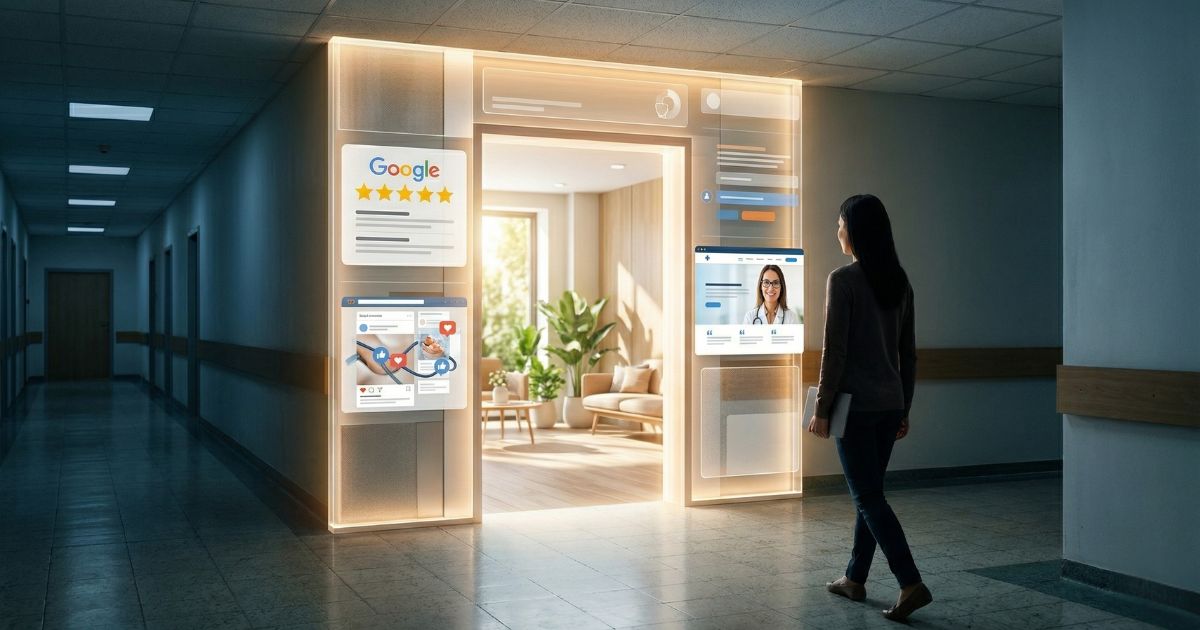
Research in psychology shows that humans form judgments within 7 seconds of encountering someone or something new. For patients, this first impression happens long before they meet you in person.
Their first impression is formed by:
- Your Google search result — what appears when they search your name
- Your social media profile — your photo, bio, content quality
- Your website — professional or outdated? Clear or confusing?
- Your Google reviews — star rating and what patients say about you
- Your office/chamber appearance — clean, modern, and organized signals competence
Once formed, first impressions are remarkably resistant to change. A patient who sees a professional, well-maintained online presence will enter your chamber already trusting you. A patient who sees an outdated website or no online presence at all will arrive skeptical — and that skepticism colors every interaction.
"Patients do not judge you by your skills — they judge you by the signals they can actually evaluate. Your job is to make those signals match your competence."
Bear My Brand2. Social Proof (The Herd Effect)
Humans are wired to follow the crowd. When uncertain, we look at what others are doing. In healthcare, this translates to: patients trust doctors that other patients trust.
This is why online reviews are so powerful. A study by Software Advice found that 72% of patients use online reviews as their very first step when searching for a new doctor. And 84% of patients trust online reviews as much as personal recommendations from friends and family.
The social proof hierarchy for doctors:
- Video testimonials from patients — the most powerful form of social proof. Seeing a real person share their positive experience is almost impossible to resist.
- Google/Facebook reviews — volume and rating both matter. 50 reviews at 4.7 stars is more trustworthy than 5 reviews at 5.0 stars.
- Social media following — a doctor with 100,000 followers is perceived as more credible than one with 200 followers, even if their clinical skills are identical.
- Media appearances and publications — being featured in news, podcasts, or medical publications signals authority.
- Awards and recognitions — certifications, fellowships, and professional awards displayed prominently.
The most common reason patients give for choosing their doctor is "someone recommended them." But in 2026, "someone" is increasingly not a friend or family member — it is a Google review, a Facebook comment, or a testimonial video. Your online social proof IS your word-of-mouth in the digital age.
3. Authority Bias (The Expert Effect)
Patients naturally defer to perceived authority figures. Two factors amplify perceived authority far beyond your actual credentials:
Visibility = Authority. The doctor who regularly appears on social media explaining health topics is perceived as more expert than the doctor who never posts — even if the quiet doctor has better credentials. Visibility creates the perception of authority because patients assume that only true experts would have the confidence and platform to educate publicly.
Education = Authority. Doctors who educate their audience — through videos, blog posts, social media content — are perceived as more knowledgeable than those who do not. Every piece of educational content you create is a deposit into your authority bank.
This is why doctors with active YouTube channels and Facebook pages consistently attract more patients. They are demonstrating their expertise in a way patients can directly evaluate — unlike a diploma on a wall that means little to a layperson.
4. The Familiarity Principle (Mere Exposure Effect)
One of the most robust findings in psychology: we trust things that are familiar. The more often someone encounters you, the more they trust you — even without any direct interaction.
This is the science behind why consistent social media posting works. A patient who has seen your face and heard your voice across 20 Facebook videos feels like they know you. When they develop a health issue, you are the first doctor they think of — not because you are the best (they cannot evaluate that), but because you are the most familiar.
The familiarity principle explains why:
- Doctors who post 3-5x per week grow faster than those who post once a week
- Video content builds trust faster than text (seeing a face and hearing a voice creates deeper familiarity)
- Patients often say "I feel like I already know you" at their first appointment — this is the familiarity principle at work
5. Emotional Connection (Affect Heuristic)
Patients make healthcare decisions emotionally first, then justify them rationally. A patient does not analyze your credentials, compare your outcomes data, and make a calculated decision. They feel something — trust, warmth, comfort, safety — and then find reasons to support that feeling.
The doctors who master emotional connection share three traits:
- They listen more than they talk. Studies show that the average doctor interrupts a patient within 11 seconds of them beginning to describe their symptoms. Doctors who let patients finish speaking are rated dramatically higher in satisfaction — even when the clinical outcome is identical.
- They use simple language. Medical jargon creates distance. Patients trust doctors who explain in words they understand. If a patient leaves confused about their diagnosis or treatment, trust erodes regardless of clinical excellence.
- They show empathy visibly. Eye contact, body language, tone of voice, and verbal acknowledgment of patient concerns. "I understand that must be frightening" builds more trust than the most detailed clinical explanation.
"People will forget what you said, people will forget what you did, but people will never forget how you made them feel."
Maya Angelou — and the most important lesson in healthcare branding6. Risk Aversion (Loss Aversion Bias)
Humans fear loss more than they desire gain. In healthcare, this translates to: patients are more motivated to avoid a bad doctor than to find the best doctor.
This is why negative reviews are disproportionately damaging. One negative review about a rude receptionist or a long wait time can undo 20 positive reviews — because patients are scanning for red flags, not green flags.
It also explains why patients avoid doctors with no online presence. The absence of information is not neutral — it feels risky. A patient thinks: "If this doctor has no reviews, no website, and no social media, what are they hiding? Why is nobody talking about them?"
The no-information state triggers risk aversion, and patients choose the doctor who reduces their uncertainty — the one with reviews, content, and a visible track record.
7. The Halo Effect
When we form a positive impression in one area, it spills over into everything else. If a patient perceives you as warm and caring, they will also assume you are clinically excellent — even without evidence. If they perceive you as a great communicator, they assume you are a great diagnostician.
This is the halo effect, and it works in both directions. A doctor with a beautiful, modern website is perceived as more competent than one with a poorly designed site — even though web design has zero correlation with medical skill. A doctor who dresses professionally and maintains a clean, organized chamber is perceived as more meticulous in their clinical work.
The halo effect means that every touchpoint matters. Your receptionist's friendliness, your waiting room's cleanliness, your social media's professionalism — they all influence how patients perceive your clinical abilities.
The halo effect works in reverse too. A rude receptionist, a dirty waiting room, a 2-hour wait, or an unprofessional social media presence will make patients doubt your clinical skills — even if you are the best doctor in the city. One bad signal contaminates the entire perception.
The Patient Decision Journey in 2026
Understanding when patients make decisions is as important as understanding why. Here is the modern patient journey:
Stage 1: Trigger (The Health Need Appears)
Something happens — a symptom, a referral, a routine check-up need. The patient decides they need a doctor. At this stage, they have high anxiety and low information. They are most susceptible to trust signals.
Stage 2: Search (Finding Options)
The patient searches — Google, Facebook, asks friends and family. 77% of patients use search engines as their first step. This is where your digital presence either wins or loses you a patient. If you do not appear in search results, you do not exist in the patient's world.
Stage 3: Evaluation (Comparing Doctors)
The patient compares 2-4 options. They evaluate:
- Reviews and ratings — the single most influential factor at this stage
- Online presence quality — professional website, active social media, educational content
- Credentials and specialization — does this doctor specialize in my specific issue?
- Convenience — location, availability, online booking option
- Gut feeling — "Does this doctor feel right for me?"
Stage 4: Decision (Booking)
The patient chooses a doctor. The friction at this point matters enormously. If booking requires calling during business hours and waiting on hold, some patients will give up and choose the doctor with online booking instead. Every barrier between decision and booking costs you patients.
Stage 5: Experience (The Visit)
The actual visit. This is where clinical excellence, communication, and patient experience either confirm or contradict the trust built during the first four stages. A great online reputation followed by a poor in-person experience is worse than having no online presence at all — because the gap between expectation and reality creates betrayal, and betrayed patients leave devastating reviews.
Stage 6: Advocacy (Post-Visit)
The patient either becomes an advocate (leaves reviews, refers friends, follows on social media) or a detractor (leaves negative reviews, warns others, never returns). The post-visit experience is heavily influenced by follow-up communication. A simple SMS or WhatsApp message the next day — "How are you feeling? Any questions about your treatment?" — dramatically increases the likelihood of a positive review and return visit.
Most doctors focus exclusively on Stage 5 — the clinical visit. But the patient has already made 80% of their trust decision before they walk through your door (Stages 2-4). And the post-visit experience (Stage 6) determines whether they become a lifelong patient or a one-time visitor. To grow your practice, you must win at every stage — not just the clinical encounter.
What Patients Say vs. What Actually Drives Their Decision
There is a fascinating gap between what patients say matters and what actually influences their behavior:
What Patients Say They Want
- "The most qualified doctor" (credentials, experience, training)
- "Someone who really knows their stuff" (clinical expertise)
- "Good bedside manner" (mentioned but not prioritized verbally)
What Actually Drives Their Choice
- How the doctor made them feel — listened to, respected, understood
- What other patients say — reviews, testimonials, word-of-mouth
- How easy it was to find and book — digital presence, convenience
- How the office/chamber looked and felt — cleanliness, modernity, organization
- How the doctor communicated — simple language, empathy, time spent
This gap exists because patients rationalize emotional decisions with logical language. They say "qualifications" because it sounds rational. But their actual decision was: "This doctor felt trustworthy."
The implication for doctors is clear: invest as much in patient experience and communication as you invest in clinical skill. The best diagnosis in the world means nothing if the patient leaves feeling unheard, confused, or rushed.
The Bangladesh Factor: Cultural Trust Dynamics
In Bangladesh, patient trust dynamics have unique cultural dimensions that every doctor should understand:
Family-Based Decision Making
In Western healthcare, patients typically make their own decisions. In Bangladesh, healthcare decisions are often family decisions. The patient's spouse, parents, children, or extended family may be involved in choosing the doctor. This means your brand needs to resonate not just with the patient, but with their decision-making circle.
Practically, this means: educational content that a patient can share with their family is more valuable than content that only the patient finds relevant. A video explaining "What to expect after heart surgery" is shared with the patient's entire family, exposing your brand to 5-10 potential referral sources.
The "Bidesh" Trust Premium
There is a deep-rooted perception in Bangladesh that foreign-trained doctors and foreign hospitals are inherently superior. This "bidesh" (foreign) premium explains the $4-5 billion medical tourism outflow. Bangladeshi patients will travel to India, Singapore, or Thailand — paying significantly more — because of the perceived trust advantage of foreign brands.
For Bangladeshi doctors, this means you need to work harder to build equivalent trust. The good news: a strong personal brand can match or exceed this "bidesh" premium. Doctors who build massive Facebook followings and demonstrate expertise through consistent content are seeing patients choose them over going abroad — because the trust built through content is personal and direct.
The Referral Chain
Doctor-to-doctor referrals carry enormous weight in Bangladesh. A recommendation from a patient's existing GP or family doctor is often the single most trusted referral source. Building relationships with other doctors — through LinkedIn, professional events, and direct outreach — is a critical trust-building strategy that many specialists neglect.
Create content in Bangla or Banglish — not English — for the Bangladeshi market. Patients trust doctors who communicate in their language because it signals "this doctor is accessible and understands people like me." The most successful doctor brands in Bangladesh post 80% of their content in Bangla.
How Doctors Can Ethically Build Patient Trust
Now that you understand the psychology, here is how to apply it — ethically and effectively:
Build Your Online Trust Signals
- Claim and optimize your Google Business Profile — this is the single highest-impact action. Get at least 30+ reviews with a 4.5+ star rating.
- Create a professional website — clear, modern, mobile-friendly, with your bio, services, patient testimonials, and online booking.
- Post educational content consistently — 3-5x per week on Facebook, 1-2x on YouTube. Familiarity breeds trust.
- Collect video testimonials — aim for 2-3 new testimonials per month. Display them prominently.
- Respond to every review — positive and negative. This shows you care about patient feedback.
Master the In-Person Experience
- Train your staff — your receptionist's behavior is a trust signal. Friendly, efficient front-desk staff set the tone for the entire visit.
- Manage wait times — if a patient waits 2 hours, no amount of clinical excellence will overcome the frustration. If delays are unavoidable, communicate proactively.
- Listen before diagnosing — let patients finish speaking. Ask follow-up questions. Repeat back what they said to show you heard them.
- Explain in simple language — avoid jargon. Use analogies. Draw diagrams. A patient who understands their condition trusts the treatment plan more.
- Make eye contact — not at your computer screen. Patients feel unseen when doctors type while they talk.
Create a Post-Visit Trust Loop
- Send a follow-up message — the next day via WhatsApp or SMS: "How are you feeling? Any concerns about the medications?"
- Make review collection effortless — create a QR code that leads directly to your Google review page. Hand it to patients after their visit.
- Provide written summaries — a one-page printed summary of the diagnosis, treatment plan, and next steps. This reduces anxiety and shows thoroughness.
- Create a recall system — automated reminders for follow-up appointments, annual check-ups, and preventive screenings.
The Trust Killers: What Destroys Patient Confidence
Trust is hard to build and easy to destroy. These are the most common trust killers:
- Dismissing patient concerns. "It is nothing, do not worry about it" may be clinically accurate but emotionally devastating. The patient felt concerned enough to visit you — validate that.
- Rushing the consultation. A 3-minute consultation after a 2-hour wait communicates: "My time matters, yours does not." Patients who feel rushed do not come back.
- Unnecessary tests and referrals. Patients are increasingly aware of over-testing as a revenue tactic. Transparency about why a test is needed builds trust; ordering tests without explanation erodes it.
- Inconsistent information. If a patient reads one thing on your social media and hears something different in person, trust collapses. Consistency across all touchpoints is essential.
- Ignoring online reputation. Negative reviews left unanswered signal that you do not care about patient feedback. Even a well-handled negative review can build trust — it shows accountability.
- Staff rudeness or inefficiency. A brilliant doctor with a rude receptionist will lose patients. Your team IS your brand.
- Poor hygiene and environment. A dirty waiting room or an unorganized chamber creates unconscious doubt: "If they cannot maintain their space, can they maintain my health?"
If a patient waits more than 1 hour without communication, trust begins to erode. After 2 hours, frustration sets in. After 3 hours, many patients will leave — and leave a negative review. If your schedule runs long, have your staff communicate delays proactively: "Doctor is running 30 minutes behind today. Would you like to reschedule or wait?" Simple communication prevents reputation damage.
Building Trust at Scale: The Content Strategy
You cannot have a one-on-one conversation with every potential patient. But you can build trust at scale through strategic content that activates the psychological principles we discussed.
Content That Triggers Social Proof
- Patient testimonial videos (with consent)
- Case study posts (anonymized): "A patient came to me with [condition]. Here is what we did."
- Screenshots of positive reviews (with patient permission)
- Milestone celebrations: "Thank you for 1,000 five-star reviews"
Content That Builds Authority
- Educational videos explaining conditions and treatments
- Myth-busting content: "5 things you believe about [condition] that are wrong"
- Reacting to health news and studies
- Behind-the-scenes of your clinical work (maintaining patient privacy)
Content That Creates Familiarity
- Day-in-the-life content
- Personal stories about why you became a doctor
- Your morning routine, your workspace, your team
- Live Q&A sessions where patients interact with you directly
Content That Triggers Emotional Connection
- Patient recovery stories (with consent)
- Addressing patient fears: "What to expect before your first [procedure]"
- Content that shows vulnerability: lessons learned, challenges faced
- Community health initiatives and charitable work
"Every piece of content a doctor creates is a trust deposit. The doctors who make consistent deposits build a trust account that no competitor can drain."
Bear My BrandFrequently Asked Questions
Common questions about patient psychology and doctor trust.
Want to Build Patient Trust at Scale?
Bear My Brand helps doctors and hospitals build trust-driven brands that attract patients — from digital strategy and content creation to reputation management and patient experience design.
Book a Free Strategy Call