
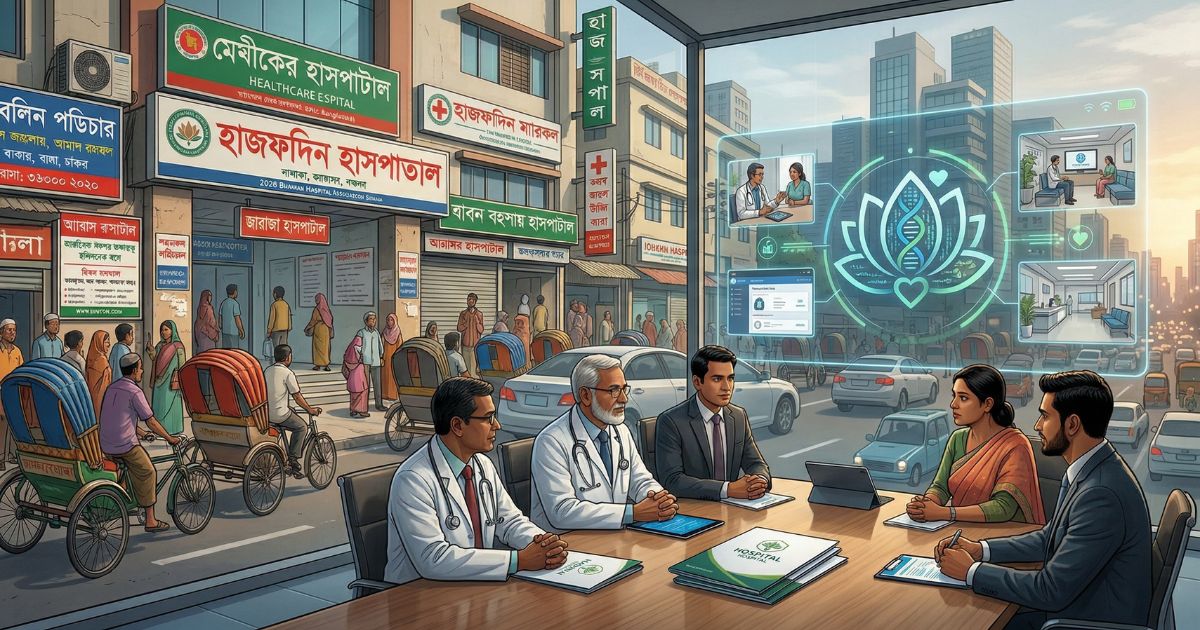
The Uncomfortable Truth About Healthcare Branding in Bangladesh
Let's start with the number that tells the whole story: Bangladeshi patients spend $4 to $5 billion every year going to India, Singapore, Thailand, and other countries for medical treatment. An estimated 450,000 to 800,000 people leave the country for healthcare annually. In 2024 alone, around 482,000 Bangladeshis went to India for treatment — making up 52% of India's entire inbound medical tourism.
Think about that for a moment. Billions of dollars leaving the country every year. Not because Bangladesh does not have skilled doctors — it does, and many of them trained at the same institutions as their Indian and Singaporean counterparts. The money leaves because of a trust and perception problem. And that is, at its core, a branding problem.
Patients do not choose the most skilled doctor. They choose the doctor they trust the most. And trust, in 2026, is built online — through content, through visibility, through professional presentation, through the feeling a patient gets when they look at a doctor's Facebook page or website.
Most doctors in Bangladesh have not figured this out yet. Not because they are not smart — they are some of the most educated professionals in the country. But because branding was never part of their training, and many still see it as undignified or unnecessary.
That mindset is costing the entire healthcare sector billions.
Where We Are Right Now: The 2026 Landscape
The Numbers
Bangladesh has 134,568 registered physicians according to BMDC (November 2024 data), plus 14,323 dentists and 2,918 medical assistants. That is roughly 8.3 doctors per 10,000 people — far below the WHO recommendation of 23 per 10,000.
The healthcare market is currently worth approximately $14 billion, with a projection to hit $23 billion by 2033. Private hospitals now deliver over 60% of healthcare services. The hospital market alone is growing at nearly 10% annually.
Meanwhile, Bangladesh's government health spending as a share of GDP sits at just 0.67% for FY2026 — the lowest among 45 least developed countries. This means the private sector is shouldering most of the healthcare delivery, and private healthcare providers need to attract patients to survive.
That is where branding comes in.
The Social Media Reality
Bangladesh has 52.9 million Facebook users — and social media usage grew 22.3% in 2024 alone. Facebook is not just a social platform here. It is the internet for most Bangladeshis. It is where they search for doctors, read health tips, watch medical videos, and decide who to trust with their health.
And here is the gap: while 85% of patients follow doctors and clinics on social media, the vast majority of doctors have no professional social media presence at all. Most who do have a Facebook page treat it as an afterthought — occasional posts, no strategy, no consistency, no brand identity.
The doctors who have figured this out are winning massively. A handful of physicians in Bangladesh have built Facebook followings in the hundreds of thousands — some over a million. Their chambers are booked weeks in advance. They command premium fees. They have waiting lists. And in many cases, their clinical skills are comparable to doctors who sit idle in their chambers waiting for patients.
The difference is not skill. It is visibility.
"In Bangladesh, your medical degree gets you the license to practice. Your brand determines whether anyone actually comes to you."
Bear My BrandWhat Is Working in Healthcare Branding Right Now
1. Educational Video Content on Facebook and YouTube
The single most effective healthcare branding strategy in Bangladesh right now is short educational videos. A doctor sitting in their chamber, speaking directly to camera about a common health concern, in simple Bangla. No fancy production. No script reading. Just a knowledgeable doctor explaining something useful.
These videos work because they do three things simultaneously: they demonstrate expertise, they build familiarity, and they create trust. When a patient watches a doctor explain their condition clearly and compassionately, they feel a connection — and when they need treatment, that doctor is the first person they think of.
The doctors crushing it on video are posting 3-5 times per week. They cover common conditions, bust myths, answer frequently asked questions, and share simple health tips. Production quality matters less than authenticity and consistency.
2. Google Business Profile Optimization
When a patient in Dhaka searches "best cardiologist near me" or "chest pain doctor Dhanmondi," Google shows a map with local doctors. The ones who appear in this map pack get the calls. The ones who do not? Invisible.
Doctors who have properly set up and regularly updated their Google Business Profile — with photos, services, operating hours, and actively managed reviews — are seeing consistent patient flow from Google alone. Yet most doctors in Bangladesh either do not have a profile or set it up once and never touched it again.
3. Professional Website with Online Booking
Having a professional website is still rare among doctors in Bangladesh. The few who have invested in a proper site — with clear service descriptions, doctor bio, patient testimonials, and online appointment booking — stand out dramatically from the competition.
A well-designed website signals professionalism and builds instant credibility. It also works 24/7 as a patient acquisition tool, especially for patients searching Google for specific medical conditions or treatments.
4. Patient Testimonial Videos
Nothing sells medical credibility like a real patient sharing their experience on camera. Doctors who systematically collect video testimonials from satisfied patients (with consent) and share them on social media are building powerful social proof that no advertising can match.
The formula that is delivering the strongest results for doctors in Bangladesh right now: 3 educational videos per week on Facebook + 1 patient testimonial video per month + active Google Business Profile with review management + a professional website with online booking. That combination, done consistently for 6 months, transforms a practice.
What Is NOT Working (And What Doctors Are Wasting Money On)
Paid Facebook Ads Without Strategy
Dozens of doctors are spending BDT 10,000-50,000 per month on Facebook ads with little to show for it. The problem is not the ads — it is that they are boosting random posts with no targeting, no landing page, and no conversion strategy. Without a professional social media presence to back it up, Facebook ads are just burning money.
Low-Quality "Digital Marketing Agencies"
The market is flooded with small agencies offering "doctor marketing packages" for BDT 5,000-10,000/month. At that price, what you get is a junior social media manager copying generic health content from Google, slapping your logo on Canva templates, and posting it with no engagement strategy. This kind of "branding" actually hurts more than it helps because it looks cheap and impersonal.
Copying Other Doctors' Content
If a cardiologist in Dhaka starts posting reels about heart health and gets traction, suddenly every cardiologist in the city is posting similar content. The copy-paste approach does not work because it lacks authenticity. Patients can tell when content is genuine versus when it is manufactured.
Ignoring Patient Experience
You can have the best social media presence in the country, but if a patient walks into your chamber and waits 3 hours, gets 5 minutes with you, feels rushed, and leaves confused about their treatment — that patient is not coming back, and they are telling everyone they know. Branding without patient experience is just marketing for one-time visits.
The most common and most expensive mistake: hiring the cheapest agency, posting generic content for 3 months, seeing no results, and concluding that "digital marketing does not work for doctors." It does work — spectacularly well. But only when done properly, with real strategy, genuine content, and long-term commitment.
Why Patients Leave Bangladesh for Treatment
Understanding why patients go abroad is essential to understanding where healthcare branding needs to go. According to multiple studies, the top reasons Bangladeshis seek treatment in India and elsewhere are:
- Lack of trust in local healthcare quality — perception, often more than reality
- Doctor behavior and communication — patients report doctors being inattentive, dismissive, or not spending enough time explaining conditions and treatments
- Unavailability of specialized treatments — cardiac surgery, oncology, organ transplants, neurosurgery
- Perception of better facilities abroad — modern equipment, cleaner hospitals, better service standards
- Long waiting times — especially at public hospitals
- Corruption and unnecessary testing — referral kickbacks and over-diagnosis erode trust
Notice that points 1, 2, and 4 are all branding and communication problems. The clinical skills may be there, but the trust is not. And trust is built through brand experience — how you communicate, how you present yourself, how patients feel before, during, and after their visit.
Indian hospitals figured this out years ago. Apollo, Fortis, Medanta — they invest heavily in brand building, patient communication, international patient coordination, and professional digital presence. The hospital with a polished website, transparent pricing, video testimonials, and a responsive online booking system feels more trustworthy than the one with a faded sign and no online presence — even if the doctors inside are equally capable.
The Next 5 Years: Where Healthcare Branding Is Going (2026-2031)
The healthcare branding landscape in Bangladesh is about to change dramatically. Here is what we see coming:
1. Telemedicine Goes Mainstream
Bangladesh's digital health market is projected to reach $849 million by 2029. The pandemic accelerated telemedicine adoption, and it is not going back. Platforms like Telenor Health's Tonic have already proven the model. By 2031, telemedicine consultations will be routine — and the doctors who build strong online brands now will be the ones patients choose for virtual appointments.
This is a fundamental shift because it removes geography from the equation. A patient in Sylhet can now consult a specialist in Dhaka without traveling. The doctor with the strongest brand and best online reviews will win — regardless of location.
2. Doctor Personal Brands Will Rival Hospital Brands
Historically, hospitals were the brand. Patients chose Square, or Evercare, or United Hospital. The doctor was secondary. That is changing. By 2031, patients will increasingly choose the doctor first and the hospital second. A doctor with 500K Facebook followers and a trusted reputation can fill chambers at any hospital they practice at.
This shift gives individual doctors enormous power — but only if they invest in personal branding now. The window to establish yourself as a leading voice in your specialty is open but closing. As more doctors enter the branding game, standing out will become harder and more expensive.
3. AI-Powered Patient Engagement
AI chatbots for appointment scheduling, automated follow-up messages, personalized health reminders — these tools are coming to Bangladesh's healthcare sector fast. Hospitals that integrate AI into their patient communication will deliver a dramatically better experience than those relying on manual systems.
Clinics using AI-powered WhatsApp bots for appointment reminders, prescription refill notifications, and post-visit check-ins will see higher patient retention and satisfaction.
4. Video-First Content Becomes Non-Negotiable
By 2031, doctors without video content will be invisible. Text posts and static images will not cut it. Short-form health videos (60-90 seconds) on Facebook Reels, YouTube Shorts, and Instagram Reels will be the primary way patients discover and evaluate doctors.
The doctors who start building their video library now will have an insurmountable advantage — years of content, algorithm history, and audience trust that newcomers cannot replicate quickly.
5. Specialized Healthcare Marketing Agencies Will Emerge
Right now, most doctors who invest in branding hire general digital marketing agencies that also serve restaurants, clothing brands, and e-commerce stores. By 2031, we predict a wave of specialized healthcare branding agencies that understand BMDC regulations, medical ethics, patient psychology, and healthcare-specific marketing strategies.
This specialization will raise the quality of healthcare branding across the board and push doctors toward more strategic, results-driven approaches instead of generic social media posting.
6. Medical Tourism Will Reverse
One of the most exciting possibilities for Bangladesh: as private hospitals invest in modern facilities, transparent pricing, and professional branding, the country has the potential to become a medical tourism destination rather than just a source of medical tourists. With competitive pricing and improving quality, Bangladesh could attract patients from neighbouring countries — if the branding and trust infrastructure is built.
7. Patient Review Platforms Will Gain Power
Dedicated doctor review platforms — similar to how Zocdoc and Healthgrades work in the US — will become influential in Bangladesh. Patients will increasingly make decisions based on verified reviews and ratings. Doctors who proactively manage their online reputation will thrive; those who ignore it will be defined by their worst reviews.
"The next 5 years will separate the doctors who invested in their brand from the ones who thought branding was beneath them. There will be no catching up."
Bear My BrandWhat Doctors Should Do Right Now
If you are a doctor in Bangladesh reading this, here is the practical roadmap:
Immediate (This Month)
- Claim and complete your Google Business Profile with photos, services, and hours
- Create a professional Facebook Page (separate from your personal profile)
- Record your first 3 educational videos — phone camera is fine, just good lighting
- Ask your 5 most satisfied patients for Google reviews
Short-Term (Next 3 Months)
- Invest in a professional website with online appointment booking
- Develop a content calendar — 3 videos and 2 posts per week minimum
- Start collecting video testimonials from patients (with written consent)
- Get professional headshots and chamber photos taken
- Set up a WhatsApp Business account for patient communication
Medium-Term (6-12 Months)
- Hire a specialized healthcare branding agency (not a generic one)
- Launch a YouTube channel for longer educational content
- Implement SEO strategy targeting your specialty and location
- Build an email/SMS list for patient follow-ups and health tips
- Develop a consistent visual brand — logo, colours, templates, brand voice
Long-Term (1-3 Years)
- Build topical authority through comprehensive health content in your specialty
- Explore telemedicine integration
- Implement AI-powered patient engagement tools
- Consider writing a book or launching a health awareness campaign
- Build a referral network with other branded doctors in complementary specialties
For Hospitals and Clinics
Hospital branding in Bangladesh is equally underdeveloped. Most hospitals rely on location, reputation through word-of-mouth, and newspaper ads. The ones that will dominate by 2031 are investing in:
- Patient experience design — not just clinical quality but the entire journey from online discovery to post-discharge follow-up
- Digital-first branding — professional websites with department pages, doctor profiles, and transparent pricing
- Content marketing — regular health content across social media, YouTube, and blog
- Reputation management — active monitoring and response to online reviews
- International patient programs — for those aiming to attract medical tourism
The hospital that cracks this formula first — world-class branding combined with genuine clinical quality — will become Bangladesh's Apollo or Fortis. The opportunity is massive.
A doctor investing BDT 200,000-500,000/year in professional branding who gains even 5 additional patients per month at an average visit fee of BDT 2,000 recoups the investment within 2-4 months. For specialists with higher consultation fees or surgical cases, the ROI is even more dramatic. Branding is not an expense. It is the highest-return investment a doctor can make outside of clinical training.
Frequently Asked Questions
Common questions about healthcare branding in Bangladesh.
Need Help With Healthcare Branding?
Bear My Brand specializes in doctor personal branding, hospital branding, and healthcare digital marketing in Bangladesh — strategy, identity, content, and growth.
Book a Free Strategy Call