
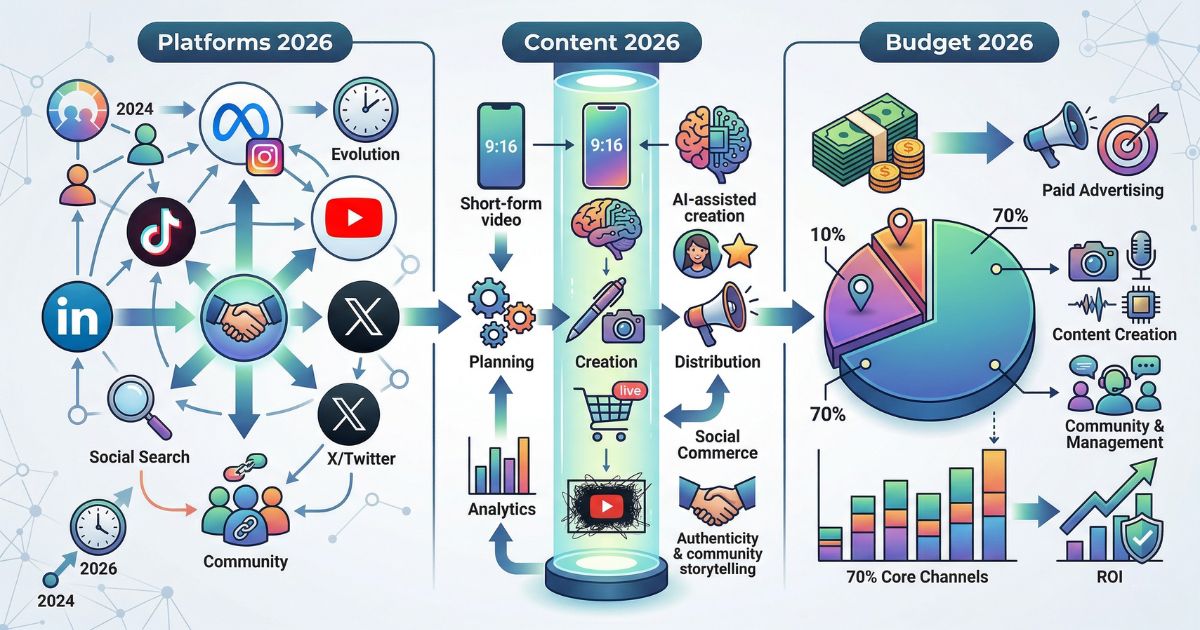
The Platform Landscape in 2026
If you are still running the same social media strategy you had in 2023, you are burning money and time. The landscape has shifted in ways that are impossible to ignore, and businesses that have not adapted are shouting into a void.
Here is what changed. TikTok cemented itself as the most powerful discovery engine on the internet. It is no longer a Gen Z dance app — it is where people of all ages go to find products, learn skills, discover brands, and make purchase decisions. Google themselves admitted that nearly 40% of young people use TikTok or Instagram instead of Google Search when looking for a place to eat.
Instagram pivoted hard into Reels and has not looked back. Carousel posts remain the king of saves and shares, but if you are not making short-form video, Instagram's algorithm is barely showing your content to your own followers. Static image posts that used to get 5-8% reach now struggle to break 2%.
LinkedIn became the most underpriced organic platform for B2B. While every other platform throttled organic reach, LinkedIn did the opposite — personal profiles are seeing engagement rates that feel like Facebook in 2014. If you are in professional services, consulting, SaaS, or any B2B space and you are not active on LinkedIn, you are leaving the easiest wins on the table.
Facebook's organic reach for business pages has cratered to an average of 0.06%. Read that number again. For every 10,000 followers, about 6 people see your post organically. Facebook is now a paid media platform with a social wrapper. It still works — but only if you are willing to pay.
YouTube Shorts exploded, giving creators a way to build audiences that then convert to long-form viewership. X (formerly Twitter) fragmented into niche communities that are either extremely valuable or completely irrelevant depending on your industry. And Threads is quietly building a user base that is growing faster than most people realise.
The bottom line: there is no single platform strategy anymore. The winning approach in 2026 is platform-specific content, realistic budgets, and relentless focus on the 1-2 platforms where your actual audience lives.
Platform-by-Platform Breakdown
Let us go through each major platform — what is working, what is dead, and whether your business should care.
Instagram in 2026 is a Reels-first platform. That is not a prediction — it is the reality. The algorithm overwhelmingly favours short-form video content, and the data backs it up: Reels get 2x more reach than image posts and significantly higher engagement across the board.
But here is what most people miss: carousel posts are the secret weapon for saves and shares. While Reels drive discovery and top-of-funnel awareness, carousels drive depth. A well-crafted 10-slide carousel that teaches something specific will get saved hundreds of times — and saves are the engagement metric Instagram's algorithm weights most heavily.
The winning Instagram strategy in 2026 looks like this:
- 4-7 Reels per week — short (15-30 seconds), hook in the first second, trending audio optional but helpful
- 2-3 carousel posts per week — educational, step-by-step, or story-driven content designed for saves
- Daily Stories — behind-the-scenes, polls, questions, casual content that builds familiarity
- 1-2 collaborative posts per month — co-create with other accounts in your niche for audience crossover
Stop obsessing over follower count. In 2026, a 5,000-follower account with 8% engagement rate and a loyal community will outperform a 100,000-follower account with 0.5% engagement every single time. The algorithm rewards engagement depth, not audience size.
TikTok
TikTok is the best organic reach opportunity in social media right now, and it is not even close. With a 5.3% average engagement rate — the highest of any major platform — and an algorithm that can push a video from a zero-follower account to a million views, TikTok is the discovery engine that every other platform is trying to copy.
What makes TikTok different from every other platform is the interest graph. Instagram and Facebook show you content from people you follow. TikTok shows you content it thinks you will like — regardless of who posted it. This means a brand-new account with zero followers can reach its exact target audience on the very first post if the content is good enough.
What is working on TikTok in 2026:
- Educational short-form — "How to" content, industry tips, myth-busting, explainers
- Personality-driven content — people follow people, not brands. Put a face on your content
- Trends with a twist — use trending sounds and formats but apply them to your industry
- Day-in-the-life and behind-the-scenes — authenticity outperforms polish every time
- TikTok Shop integration — for e-commerce brands, in-video shopping is a game changer
The businesses succeeding on TikTok are the ones willing to be real. Not corporate. Not scripted. Not polished to the point of being sterile. TikTok rewards personality, speed, and a willingness to be slightly imperfect.
TikTok views do not automatically equal business results. Viral videos with millions of views can generate zero revenue if the audience is not your target customer. Focus on content that attracts your specific buyer, not content that just gets views. A video with 10,000 views from your exact target audience is worth more than 1 million views from random teenagers.
LinkedIn in 2026 is the most underrated platform in social media marketing, and the numbers prove it. The platform is seeing a 6.5% organic engagement rate on posts — a number that would have sounded insane on any platform five years ago. But the real stat that should make every B2B marketer sit up is this: personal posts on LinkedIn get 561% more reach than company page posts.
That is not a typo. Five hundred and sixty-one percent.
LinkedIn has become the platform where founders, executives, and employees build personal brands that directly drive business results. Company pages still matter for credibility and ads, but the organic growth engine is personal profiles.
What is working on LinkedIn:
- Long-form text posts — storytelling, lessons learned, hot takes on industry trends (1,000-1,500 characters sweet spot)
- Document posts (carousels) — PDF slides that teach something step-by-step (these get massive reach)
- Native video — short, direct-to-camera insights. Do not over-produce. Speak like a human
- Commenting strategy — thoughtful comments on other people's posts can drive more profile visits than your own content
- Polls — still get disproportionate reach because they drive easy engagement
If you are a B2B business, professional service provider, consultant, or agency — LinkedIn should be your primary organic platform. No question.
Let us be honest about Facebook. Organic reach for business pages is effectively dead. At 0.06% average reach, Facebook has become a paid media platform. You pay to play, or you do not play at all.
But that does not mean Facebook is irrelevant. It still has 3.07 billion monthly active users — the largest social network on the planet. The audience is there. You just have to pay to reach them.
Where Facebook still works in 2026:
- Facebook Ads — still one of the best paid advertising platforms, especially for e-commerce and local businesses. The targeting capabilities and cost-per-acquisition are hard to beat
- Facebook Groups — the one organic bright spot. Active groups with genuine community engagement still drive meaningful reach and connection. If you can build or participate in a relevant group, do it
- Facebook Marketplace — increasingly important for local and product-based businesses
- Retargeting — Facebook's pixel and retargeting capabilities remain best-in-class for warming up audiences who have already visited your website
"Facebook is not dead — it just stopped being free. The businesses that treat it as a paid channel and stop expecting organic miracles are the ones seeing strong returns."
Bear My BrandYouTube
YouTube is the only social platform where content genuinely compounds over time. A blog post from 2024 might still rank on Google. A TikTok from 2024 is buried. But a YouTube video from 2024 can still generate views, leads, and revenue every single day in 2026 — because YouTube is a search engine, not just a social feed.
The dual strategy that is dominating YouTube right now:
- Long-form (8-20 minutes) — deep-dive tutorials, case studies, industry analysis, how-to guides. These build authority, trust, and searchable evergreen content
- YouTube Shorts (under 60 seconds) — quick tips, hot takes, and repurposed clips from long-form content. Shorts drive subscriber growth; long-form drives watch time and conversions
The biggest mistake businesses make with YouTube is expecting overnight results. YouTube is a long game. The first 50 videos are your learning curve. But once the flywheel starts spinning — once you have a library of searchable content — the compound effect is unlike anything other platforms can offer.
X (Twitter)
X is a polarising platform in 2026. Since the rebrand and the various changes to verification, moderation, and algorithm, some communities have thrived while others have scattered.
Where X still has value:
- Tech, crypto, finance, and startup communities — these niches remain extremely active and engaged
- Real-time conversation — for brands that need to be part of trending discussions, X is still the fastest platform
- Thought leadership threads — long-form tweet threads still get significant reach when they go deep on a specific topic
Where X falls short: if your audience is not in tech, finance, or media, your time is probably better spent elsewhere. The general consumer audience has become harder to reach organically, and the ad platform is less robust than Meta's or Google's.
Threads
Threads is the sleeper platform of 2026. Launched by Meta as a competitor to X, it had a rocky start — massive sign-ups followed by a user drop-off. But Meta kept investing, and by mid-2025, Threads found its groove.
The platform now has a growing, engaged user base of people who wanted the conversation-style format of Twitter without the toxicity. For brands, Threads offers:
- Strong organic reach — the algorithm is still generous to new content creators
- Cross-posting from Instagram — seamless integration with your existing Instagram audience
- Text-first conversations — a refreshing alternative for brands that excel at written content
Threads is not a must-have platform yet, but it is worth watching and experimenting with — especially if you already have an Instagram presence.
Which Platforms Should Your Business Be On?
This is the question that matters more than any platform breakdown. Because the worst social media strategy is trying to be everywhere at once. You end up doing six platforms badly instead of two platforms brilliantly.
Here is a decision framework that actually works:
If You Are a B2B Company
- Primary: LinkedIn (personal profiles of founders and key team members)
- Secondary: YouTube (long-form thought leadership and tutorials)
- Optional: X/Twitter (if your industry is active there), TikTok (if you have someone willing to be the face)
- Skip: Facebook organic (pay for ads only), Instagram (unless your product is visual)
If You Are a B2C Brand (E-commerce, Lifestyle, Consumer)
- Primary: Instagram + TikTok (these two together cover discovery and community)
- Secondary: YouTube Shorts (repurpose TikTok/Reels content)
- Optional: Facebook (ads and groups), Pinterest (if your product is visual/aspirational)
- Skip: LinkedIn (unless you are also building a personal brand)
If You Are a Local Business
- Primary: Google Business Profile (not social media, but your most important local digital asset)
- Secondary: Facebook (groups, marketplace, local ads), Instagram (visual presence)
- Optional: TikTok (local discovery is growing fast on TikTok)
- Skip: LinkedIn, X, Threads (unless your local business is B2B)
The Age Factor
Your audience's age matters more than most businesses want to admit:
- Under 25: TikTok first, Instagram second, YouTube third. They are not on Facebook or LinkedIn
- 25-40: Instagram, TikTok, LinkedIn (if professional), YouTube. This group is on everything, but their attention is on short-form video
- 40-55: Facebook, Instagram, LinkedIn, YouTube. This is where Facebook still has real engagement
- 55+: Facebook dominates. YouTube is second. Everything else is marginal
Pick a maximum of 2 platforms. Master them completely. Post consistently for 6 months before adding a third. A mediocre presence on 5 platforms will always lose to a dominant presence on 2.
Short-Form vs Long-Form Video — The 2026 Debate
This is one of the most debated topics in content marketing right now: should you invest in short-form video (Reels, TikTok, Shorts) or long-form video (YouTube, podcasts, webinars)? The honest answer is that both serve different purposes, and the best strategies use both — but not equally.
When Short-Form Wins
Short-form video (under 60 seconds) is the most effective format for:
- Awareness and discovery — reaching people who have never heard of you
- Trend participation — staying culturally relevant and showing personality
- Testing ideas — short-form is cheap and fast to produce, making it ideal for figuring out what resonates
- Building familiarity — the more people see your face in their feed, the more they trust you when it matters
- Social proof — quick testimonials, before/after results, product demos
Short-form is your top-of-funnel machine. It is how strangers become aware of you.
When Long-Form Wins
Long-form video (8-60 minutes) is the most effective format for:
- Deep trust building — spending 20 minutes with someone creates a relationship that 30 seconds cannot
- Search visibility — YouTube is the second-largest search engine. Long-form content ranks and generates traffic for years
- Complex topics — if you are explaining something nuanced, you need time
- High-ticket sales — people making expensive purchasing decisions need more than a 15-second Reel to feel confident
- Repurposing — one 20-minute video can be cut into 10-15 short-form clips
Long-form is your trust machine. It is how aware audiences become convinced buyers.
The Ideal Ratio
For most businesses in 2026, the sweet spot is 70% short-form, 30% long-form. Short-form fills the top of the funnel cheaply and consistently. Long-form converts the audience you have built. If you can only do one, start with short-form — it is faster, cheaper, and builds an audience that you can later convert with long-form content.
"Short-form gets you noticed. Long-form gets you trusted. The brands winning in 2026 are the ones doing both — and they are using short-form to drive audiences to long-form."
Bear My BrandOrganic vs Paid: The Realistic Budget Split
Here is a truth that a lot of social media marketers do not want to say out loud: organic-only social media marketing is no longer a viable growth strategy for most businesses. It still works on TikTok and LinkedIn, but across the broader landscape, you need paid amplification to reach enough people consistently.
That does not mean you need a massive budget. It means you need a realistic one. Here is what actually works at different budget levels.
Small Business: $1,000 - $3,000 per Month
This is where most small businesses and startups should start. At this level, every dollar matters, so efficiency is everything.
- 60% Content Creation ($600-$1,800) — invest in creating quality content. This might mean hiring a freelance content creator, paying for a basic editing tool, or allocating your own time. Good content is the foundation
- 30% Paid Amplification ($300-$900) — do not spread this across platforms. Pick your single best-performing organic post each week and put $75-$225 behind it. Boosting proven organic content is the highest-ROI paid strategy at this budget
- 10% Tools ($100-$300) — scheduling tool (Buffer, Later), basic analytics, stock assets if needed
At this budget, focus on one platform only. Post consistently, boost your best content, and measure what converts. Do not try to be on four platforms with a $2,000 budget — you will get zero results everywhere.
Medium Business: $5,000 - $15,000 per Month
This is where you start seeing real momentum. You can afford dedicated content production and meaningful ad spend.
- 40% Content Production ($2,000-$6,000) — professional video production, graphic design, copywriting. At this level, your content should look good and be consistent
- 45% Paid Media ($2,250-$6,750) — run proper ad campaigns, not just boosted posts. Build retargeting funnels, create lookalike audiences, test different ad creatives. This is where a proper paid strategy kicks in
- 15% Tools and Management ($750-$2,250) — better scheduling and analytics tools, possibly a social media manager (part-time or freelance)
At this level, you should be on 2 platforms with distinct strategies for each. Your organic content feeds your paid strategy — the best organic posts become ads, and your ads drive traffic back to organic content.
Large Business: $25,000+ per Month
At this budget, you are running a full-scale social media operation with dedicated team members, multi-platform campaigns, and sophisticated measurement.
- 30% Content Production ($7,500+) — in-house or agency content team, professional video, photography, copywriting across multiple formats and platforms
- 55% Paid Media ($13,750+) — full-funnel ad strategy across multiple platforms, influencer partnerships, sponsored content, brand awareness campaigns plus direct response
- 15% Team, Tools, and Analytics ($3,750+) — dedicated social media manager(s), enterprise analytics, social listening tools, competitive analysis
The number one mistake businesses make with social media budgets is spending money on ads before they have content worth promoting. If your organic content does not get engagement from your existing audience, paying to show it to more people will not fix the problem. Fix the content first. Then amplify it.
Content Calendar Framework
If you do not have a content calendar, you do not have a strategy — you have a hope. Consistency is the single biggest predictor of social media success, and a content calendar is how you maintain it.
The 60/25/15 Rule
This is the content mix that works across industries and platforms:
- 60% Educational Content — teach your audience something valuable. How-to guides, tips, industry insights, myth-busting, frameworks, templates. This is the content that builds authority and trust. It is the reason people follow you and the reason they eventually buy from you
- 25% Personal/Brand Content — behind-the-scenes, founder stories, team spotlights, opinions and hot takes, failures and lessons learned. This is the content that makes people feel connected to you as a human being, not just a business
- 15% Promotional Content — case studies, testimonials, service showcases, offers, calls to action. This is the content that directly drives revenue — but it only works because the other 85% built the trust and attention first
Batch your content creation. Dedicate one day per week (or two days per month) to creating all your content for the upcoming period. Shooting 10 Reels in one afternoon is dramatically more efficient than trying to create one Reel every day. Batching saves time, ensures consistency, and reduces the daily decision fatigue that kills most content strategies.
Posting Frequency by Platform
How often should you actually post? Here are the frequencies that balance reach with sustainability:
- TikTok: 1-3 times per day. Yes, daily. The algorithm rewards volume, and production does not need to be high — authenticity beats polish
- Instagram Reels: 4-7 per week. Daily is ideal, but 4-5 high-quality Reels beats 7 mediocre ones
- Instagram Carousels: 2-3 per week. These take more effort to create but generate saves and shares
- Instagram Stories: Daily. 3-7 story frames per day keeps you top of mind
- LinkedIn: 3-5 times per week for personal profiles. 2-3 for company pages
- Facebook: 3-5 times per week (mostly for ad-supported distribution)
- YouTube Long-Form: 1-2 per week (consistency over frequency — weekly is fine)
- YouTube Shorts: 3-5 per week (repurpose from TikTok/Reels)
- X/Twitter: 1-3 times per day if active (it is a high-frequency platform)
- Threads: 3-5 times per week (still testing waters, consistency matters)
Do not commit to a posting frequency you cannot sustain for 12 months. Posting 5 times a day for two weeks and then disappearing for a month is worse than posting 3 times a week consistently for a year. The algorithm rewards consistency. Your audience rewards reliability. Pick a frequency you can actually maintain.
Content Themes by Day
One way to simplify your content calendar is to assign themes to specific days. Here is an example framework:
- Monday: Industry tip or educational content (60% bucket)
- Tuesday: Behind-the-scenes or personal story (25% bucket)
- Wednesday: Trending topic or hot take (60% bucket)
- Thursday: Case study or client result (15% bucket)
- Friday: Fun, casual, or community-building content (25% bucket)
This framework removes the daily "what should I post?" question and ensures you naturally hit the 60/25/15 ratio without overthinking it.
Metrics That Actually Matter
This is where most businesses get social media wrong. They stare at follower counts and like counts — vanity metrics that look good in reports but do not pay the bills. The metrics that actually matter in 2026 tell you whether social media is driving real business outcomes.
The Metrics That Matter
- Engagement Rate — not total likes, but likes + comments + shares + saves divided by reach. This tells you what percentage of people who see your content actually interact with it. A 5% engagement rate with 1,000 reach is better than a 0.3% rate with 100,000 reach
- Saves — the most important engagement metric on Instagram and increasingly on other platforms. When someone saves your content, they are telling the algorithm "this is valuable enough to come back to." Saves correlate directly with reach amplification
- Shares — when someone shares your content, they are putting their own reputation behind it. Shares are the highest form of social proof, and algorithms treat shared content as the most valuable signal
- DMs and Conversations — if your content is driving direct messages, you are doing something right. DMs represent the warmest leads in social media. People who DM you are significantly more likely to become customers
- Click-Through Rate (CTR) — for posts with links, what percentage of people actually click? This tells you whether your content is compelling enough to drive action beyond the platform
- Conversions — leads generated, purchases made, calls booked. This is the metric that connects social media to revenue. Use UTM parameters, landing pages, and conversion tracking to measure this properly
The Metrics That Do Not Matter
Stop reporting on these as if they mean something:
- Follower count — a vanity number. You can have 500,000 followers and zero sales. Follower count tells you nothing about business impact
- Impressions without context — 1 million impressions sounds impressive until you realise nobody engaged with or acted on any of them
- Total likes — a post with 5,000 likes and zero website visits did nothing for your business. Likes are acknowledgement, not action
- Follower growth rate in isolation — growing by 1,000 followers means nothing if none of them are your target audience
"If your social media report does not include a line that connects activity to revenue, you do not have a marketing report — you have a popularity contest scorecard."
Bear My BrandHow to Set Up Proper Tracking
Here is the minimum measurement stack every business should have:
- Google Analytics 4 with UTM tracking on every link shared on social media
- Platform-native analytics (Instagram Insights, TikTok Analytics, LinkedIn Analytics)
- Conversion tracking pixels installed on your website (Meta Pixel, TikTok Pixel, LinkedIn Insight Tag)
- A simple spreadsheet or dashboard tracking weekly: engagement rate, website clicks, leads generated, revenue attributed
- Monthly review that compares cost of social media marketing (time + money) against revenue it generated
Ask every new lead and customer: "How did you hear about us?" It is the simplest, most underrated tracking method. Platform analytics will never capture the full picture — people discover you on TikTok, research you on Google, and convert through your website. Asking them directly fills the gaps that analytics miss.
Putting It All Together
Social media marketing in 2026 is not about being everywhere and doing everything. It is about making deliberate choices — the right platforms, the right content, the right budget — and executing with relentless consistency.
Here is your action plan:
- Audit your current platforms. Where is your audience actually engaging? Where are you wasting time? Cut the dead weight
- Pick 1-2 primary platforms based on the decision framework above. Go all in
- Build your content calendar using the 60/25/15 rule. Assign themes to days. Batch your creation
- Set a realistic budget. Even $500/month in paid amplification is better than zero. Boost your best organic content first
- Measure what matters. Set up proper tracking. Review weekly. Adjust monthly. Stop counting likes and start counting conversions
- Commit to 6 months minimum. Social media success compounds over time. The businesses that win are the ones that showed up consistently when nobody was watching — until everyone was
The social media landscape will keep changing. New platforms will emerge. Algorithms will shift. But the fundamentals stay the same: know your audience, create content they value, be consistent, and measure what matters. Do those four things better than your competitors, and you will win — regardless of what platform is trending next year.
Frequently Asked Questions
Common questions about social media marketing strategy in 2026.
Need Help With Social Media Marketing?
Bear My Brand builds social media strategies that drive real business results — content creation, paid campaigns, and full-funnel management, all under one roof.
Book a Free Strategy Call