
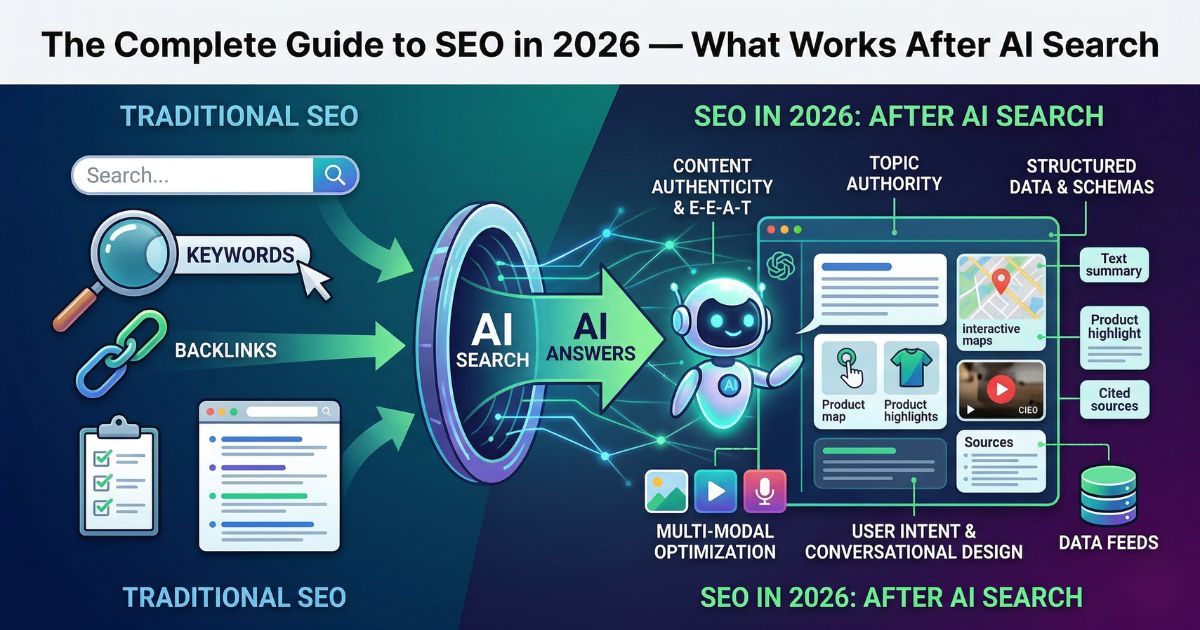
The State of Search in 2026 — What Has Changed
Let's get the big picture right before we talk tactics. Here is what the search world looks like right now:
Google is still dominant — processing over 8.5 billion searches per day. But how Google displays results has fundamentally shifted. AI Overviews (previously called SGE) now appear on roughly one-quarter of all searches, giving users an AI-generated summary at the top of the results page. For many queries, users never scroll down to the organic results.
ChatGPT has become a search engine. OpenAI's search integration means millions of people now ask ChatGPT questions they would have Googled. In some verticals — particularly tech, health, and education — ChatGPT handles up to 17.1% of queries that previously went to Google.
Perplexity, Claude, and other AI tools are carving out niches in research-heavy searches. When someone needs a thorough, well-sourced answer to a complex question, these tools are increasingly the first stop.
The result? 58% of Google searches now end without a click. Users get their answer directly from the search results page — whether from an AI Overview, a featured snippet, or a knowledge panel.
Does this mean SEO is dead? Not even close. It means SEO has evolved from "rank on page one and get clicks" to "be the source that AI models reference, featured snippets pull from, and users trust enough to click through to."
"The question is no longer 'how do I rank #1 on Google?' It is 'how do I become the source that every search interface — Google, ChatGPT, Perplexity, voice assistants — trusts and cites?'"
Bear My BrandWhat Still Works in SEO (And Works Better Than Ever)
Topical Authority
This is the single most important SEO concept in 2026. Google's algorithms now evaluate whether your entire website is authoritative on a topic — not just whether a single page has the right keywords.
What this means in practice: if you write one blog post about "SEO tips," Google does not trust you as an SEO authority. But if you have 30 interconnected pieces of content about SEO — covering strategy, technical SEO, content optimization, link building, local SEO, AI optimization — Google recognises you as a topical authority and ranks all your content higher.
This is why content clusters and pillar page strategies work so well. You build a comprehensive pillar page on a broad topic, then surround it with detailed supporting content on subtopics, all interlinked. Each piece reinforces the others.
E-E-A-T (Experience, Expertise, Authoritativeness, Trustworthiness)
Google's quality guidelines have made E-E-A-T the standard for evaluating content. The first "E" — Experience — was added in 2023, and in 2026 it matters more than ever. Google wants to see that the person or organisation creating content has actual, real-world experience with the topic.
What this means for your content:
- Include author bios with credentials and relevant experience
- Share first-hand case studies and results — not just theory
- Reference your own data and client work where possible
- Get cited by other authoritative sources in your industry
- Maintain accurate, up-to-date content — audit and refresh regularly
Technical SEO Fundamentals
The basics have not changed — they have just become table stakes. If your technical SEO is not solid, nothing else matters.
- Core Web Vitals: LCP under 2.5s, FID under 100ms, CLS under 0.1
- Mobile-first: site must work flawlessly on mobile devices
- HTTPS: non-negotiable since 2018, still matters
- Clean URL structure: descriptive, short, keyword-relevant
- Proper internal linking: every important page within 3 clicks of the homepage
- XML sitemap and robots.txt: submitted and error-free
- Structured data / Schema markup: FAQ, Article, Organization, LocalBusiness
- Crawl budget optimization: no orphaned pages, no infinite crawl traps
What Is New: AEO and GEO
AEO — Answer Engine Optimization
AEO is about optimizing your content to appear as the direct answer in AI-powered search interfaces. This includes Google's AI Overviews, featured snippets, voice assistant responses, and any other interface that provides answers without requiring users to click through to a website.
How to optimize for AEO:
- Structure content around questions. Use actual questions as H2s and H3s. Answer them concisely in the first 40-60 words, then elaborate.
- Add FAQ schema to every important page. This is not optional anymore. FAQ schema gives search engines a structured, machine-readable version of your Q&A content.
- Write definitions and explanations clearly. "What is [X]?" queries are the most common featured snippet triggers. Define terms in a single, clean sentence.
- Create comparison content. "[X] vs [Y]" queries are exploding. Tables and structured comparisons get featured frequently.
- Use numbered lists and step-by-step formats. These are the most commonly featured content structures in AI Overviews.
GEO — Generative Engine Optimization
GEO is the newest frontier. It is about getting your content cited by AI models — ChatGPT, Claude, Gemini, Perplexity — when they generate answers to user queries.
This is different from AEO because generative AI models do not just extract snippets from your content. They synthesise information from multiple sources and generate original responses, sometimes citing the sources they drew from. Being one of those cited sources is the new equivalent of ranking #1.
How to optimize for GEO:
- Publish original research and data. AI models prioritise unique, citable information — not regurgitated advice from other sources.
- Build your brand's mentions across the web. The more your brand and content appear across authoritative sources, the more likely AI models are to reference you.
- Keep content updated. AI models are trained on relatively recent data. Content that is current and frequently updated has a higher chance of being included in training data and retrieval results.
- Be the definitive source. If you want AI to cite you on a topic, be the most comprehensive, most data-backed, most authoritative source available.
Start adding unique data points and statistics to your content. "According to our analysis of 500 clients..." or "Based on our 2026 survey of 1,000 businesses..." — this type of proprietary data is what AI models cite, because it cannot be found anywhere else.
What Is Dead (Stop Doing These)
Keyword Stuffing
This has been "dead" for years, but people keep doing it. In 2026, with AI models evaluating content quality, stuffing keywords into every sentence is not just ineffective — it actively hurts you. Google's language models understand context, synonyms, and intent. Write for humans. The keywords will be there naturally.
Thin Content at Scale
Publishing 100 low-quality, 500-word blog posts is worse than publishing 20 comprehensive, deeply researched articles. Google's Helpful Content system specifically targets websites that produce large volumes of low-quality content. One excellent piece outperforms ten mediocre ones every single time.
Link Farms and PBNs
Private blog networks and purchased link packages from sketchy providers are more dangerous in 2026 than ever. Google's link spam detection is AI-powered now. The penalty is not just losing the fake link value — it is potentially losing rankings across your entire site.
Exact-Match Domains
Buying "best-seo-agency-2026.com" does not help. It signals spam. Build authority on a branded domain instead.
AI-generated content that is published without editing, fact-checking, or adding genuine expertise is getting flagged and deranked. Google does not penalise AI content outright — but it penalises content that lacks originality, accuracy, and genuine value, regardless of how it was produced.
On-Page SEO Checklist for 2026
This is the practical checklist you should run through for every important page on your site:
- Title tag: primary keyword near the front, under 60 characters, compelling
- Meta description: 150-160 characters, includes keyword, has a clear call to action
- URL: short, descriptive, includes primary keyword
- H1: one per page, includes primary keyword, matches search intent
- H2s and H3s: structured logically, include semantic keywords and questions
- First 100 words: include primary keyword naturally
- Images: compressed, descriptive alt text, next-gen formats (WebP/AVIF)
- Internal links: 3-5 relevant internal links per 1,000 words
- External links: cite authoritative sources where appropriate
- Schema markup: appropriate type for the page (Article, FAQ, Product, etc.)
- Content depth: comprehensive enough to fully answer the search query
- Mobile readability: short paragraphs, clear formatting, scannable headings
Local SEO in 2026
If you serve a specific geographic area, local SEO is not optional. It is the difference between appearing in the map pack (where 42% of local searches lead to clicks) and being invisible.
The essentials:
- Google Business Profile: Complete every field. Add photos weekly. Post updates. Respond to every review within 24 hours.
- NAP consistency: Your Name, Address, and Phone number must be identical across every directory and citation source.
- Local content: Create content that references your geographic area naturally — not just "SEO services in [city]" pages, but genuinely useful local content.
- Reviews: The number, recency, and quality of your Google reviews directly impact local rankings. Build a system for requesting reviews after every positive interaction.
- Local schema markup: LocalBusiness, GeoCoordinates, OpeningHoursSpecification — these help search engines understand exactly where you are and when you operate.
Content Strategy for the AI Era
The content strategy that works in 2026 is not about publishing more. It is about publishing better, more strategically, with a clear plan for how each piece fits into your overall authority.
The Hub-and-Spoke Model
Build content in clusters:
- Hub page (pillar): A comprehensive, 3,000-5,000 word guide on a core topic. This is your main ranking target.
- Spoke pages (supporting): 10-20 focused articles covering specific subtopics in depth. Each links back to the hub.
- The hub links out to all spokes, and spokes cross-link to each other. This creates a web of topical authority that search engines love.
Content Refresh Cadence
Every piece of content you publish starts losing freshness value over time. Set a schedule:
- High-traffic pages: Audit and update every 3 months
- Medium-traffic pages: Update every 6 months
- All pages: Annual review at minimum
A refreshed article with updated statistics, new sections, and current information often outperforms a brand-new article. Google explicitly rewards freshness for many query types.
Writing for Humans and Machines
The best SEO content in 2026 does both at once:
- Clear, engaging writing that humans actually want to read (not keyword-stuffed robot text)
- Structured with headings, lists, tables, and FAQ sections that machines can parse and feature
- Includes unique insights, data, and perspectives that cannot be found elsewhere
- Answers the actual question behind the search query — not just the literal keywords
"The best SEO strategy in 2026 is embarrassingly simple: create the most useful, most comprehensive, most trustworthy content on your topic — and make it easy for every search interface to find, parse, and cite it."
Bear My BrandMeasuring SEO Success in 2026
Traditional SEO metrics still matter, but you need new ones too:
- Organic traffic — still the baseline metric, but track it knowing that zero-click searches may reduce overall click volume
- Impressions and impression share — how often your pages appear in results, even if users do not click
- AI Overview citations — is your content being referenced in Google's AI Overviews?
- Brand search volume — are more people searching for your brand name over time? This is the strongest signal of brand authority.
- Topical authority score — tools like Ahrefs and Semrush now measure how authoritative your domain is on specific topics
- Conversion rate from organic — traffic means nothing if it does not convert. Track organic traffic to leads, sales, and revenue.
Frequently Asked Questions
Common questions about SEO in 2026.
Need Help With Your SEO?
Bear My Brand builds SEO strategies that work in the AI search era — from technical optimization to content strategy, AEO, and GEO.
Book a Free Strategy Call