
The Real Question Nobody Is Asking
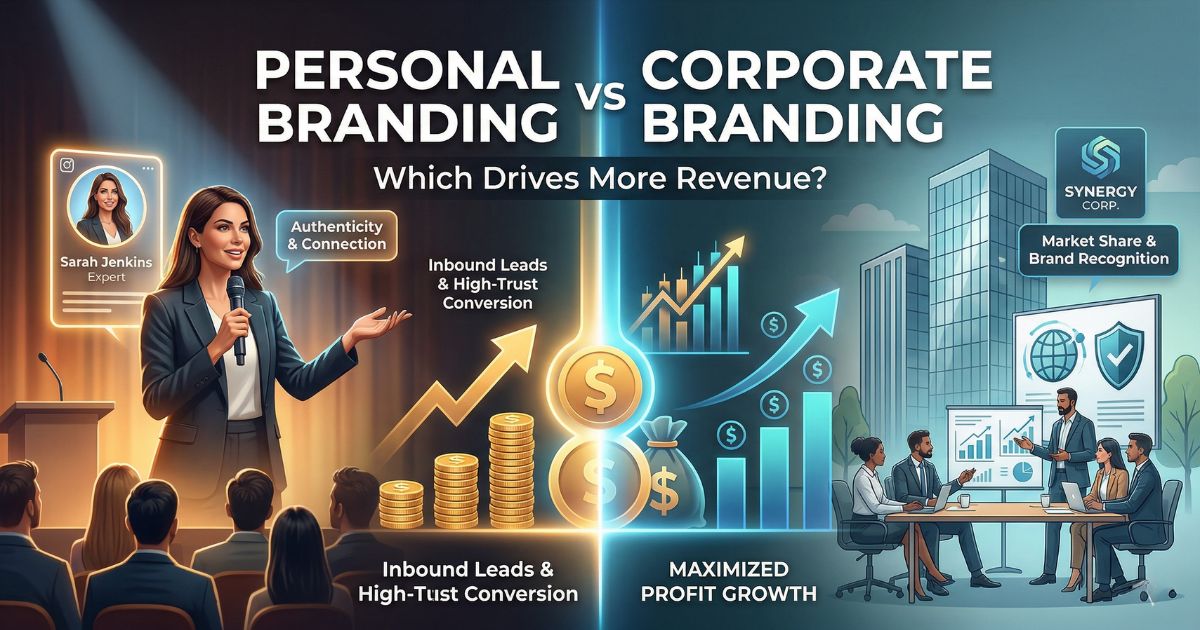
Here is what most branding articles get wrong: they treat personal branding and corporate branding as competing strategies. Like you have to pick one. That is not how it works in 2026, and it is not how the most successful companies have ever operated.
The question is not "which one is better." The question is which one should you lead with, given where you are right now — and how do you build both so they reinforce each other instead of competing for attention?
Because here is the uncomfortable truth that branding agencies do not love admitting: the fastest-growing companies in 2026 are not being built by corporate brand campaigns. They are being built by individuals who show up, share their thinking, and attract audiences — and then convert that attention into company revenue.
But there is also a ceiling to personal branding that nobody talks about. And if you do not plan for it, you will build a business that cannot function without you standing in front of a camera.
What Personal Branding Actually Means in 2026
Personal branding is not about being famous. It is about being known for something specific by the people who matter to your business. That is an important distinction.
In practical terms, personal branding means:
- You are the face people associate with a particular expertise or industry
- Your name comes up in conversations before your company name does
- People follow you, engage with your content, and trust your opinion
- Opportunities — partnerships, speaking gigs, media, clients — come through your personal reputation
The reason personal branding is so powerful in 2026 comes down to one thing: algorithms favour people over logos. Every major social platform — LinkedIn, Instagram, TikTok, X, YouTube — gives more organic distribution to individual profiles than to company pages. This is not a bug; it is by design. Platforms want authentic, human content because that is what keeps users scrolling.
LinkedIn's own data confirms this: posts from personal profiles receive 561% more reach than identical content shared from company pages. On Instagram, creator accounts consistently outperform business accounts in organic reach. TikTok does not even have traditional "company pages" — it is all individual creators.
This is not a trend. It is the new infrastructure of attention. And if you ignore it, you are paying a massive visibility tax on every piece of content your company produces.
The Elon Musk Effect
Whether you like the man or not, Elon Musk is the most extreme case study in personal branding driving corporate value. Tesla spends exactly $0 on traditional advertising. Zero. Meanwhile, every tweet Musk sends about Tesla generates millions in earned media coverage.
When Musk acquired Twitter (now X), Tesla's brand was not affected because it was built on his personal brand. When he posts something controversial, Tesla sales still grow because the personal brand and corporate brand are so intertwined that one constantly feeds the other.
You do not need to be Musk. But the principle applies at every scale. A local dentist who posts educational content on Instagram will attract more patients than a dental clinic with a polished brand page and zero personality behind it.
What Corporate Branding Does That Personal Branding Cannot
If personal branding is so powerful, why do companies still spend millions on corporate branding? Because corporate branding does things that personal brands simply cannot do.
Scalability
A personal brand does not scale. It is, by definition, tied to one person. When that person stops posting, stops showing up, or gets sick — the brand goes quiet. A corporate brand can have ten people, a hundred people, or ten thousand people representing it simultaneously. It does not depend on any single individual.
Institutional Trust
When a company is making a six-figure purchase, they are not buying from a personality. They are buying from an institution. Enterprise B2B sales, government contracts, healthcare procurement, financial services — these markets require institutional credibility that a personal brand alone cannot provide.
Nobody signs a $500,000 SaaS contract because the founder's LinkedIn posts are entertaining. They sign because the company brand signals reliability, process, security, and longevity.
Exit Value
A business built entirely on a personal brand is worth significantly less at acquisition. Investors and acquirers know that when the founder leaves, the audience leaves. Companies with strong corporate brands — independent of any one person — command higher multiples because the brand equity transfers with the sale.
The Head-to-Head Comparison
| Factor | Personal Brand | Corporate Brand |
|---|---|---|
| Organic reach | 10x higher on social media | Requires paid amplification |
| Trust factor | Immediate — people trust people | Takes longer to build |
| Cost to start | Near-zero (time investment) | $5,000–$50,000+ |
| Scalability | Limited to one person's capacity | Scales with team and systems |
| Speed to results | Fast — weeks to months | Slow — months to years |
| Enterprise credibility | Low for large deals | High — expected by procurement |
| Exit / acquisition value | Low — too founder-dependent | High — brand equity transfers |
| Algorithm advantage | Strong — platforms push people | Weak — pay-to-play era |
| Longevity | Tied to founder's lifespan and interest | Can outlive any individual |
| Emotional connection | Deep — humans relate to humans | Broad — identity and belonging |
When Personal Branding Is the Right Lead Strategy
Lead with personal branding when:
- You are in the first 1-3 years of business. Your company has no brand equity yet. Your personal reputation is the only asset you have. Use it.
- You are in a relationship-driven industry. Consulting, coaching, real estate, financial advising, healthcare, creative services — industries where people buy from people, not logos.
- Your marketing budget is limited. Personal branding costs time, not money. You can build a meaningful audience on LinkedIn or Instagram without spending a dollar.
- You are a solo founder or small team. There is no one else to be the face of the brand. Hiding behind a logo when you are the only person in the company is a waste of your biggest asset.
- You are in a crowded market. When every competitor has a clean website and a blue logo, the company with a visible, opinionated founder stands out instantly.
"People do not connect with businesses. They connect with the people behind businesses. The most expensive mistake you can make in 2026 is hiding the humans inside your company."
Bear My BrandWhen Corporate Branding Is the Right Lead Strategy
Lead with corporate branding when:
- You are seeking investment or planning an exit. VCs and acquirers want company brand equity that exists independently of the founder.
- You sell to enterprise or government. Procurement teams evaluate the company, not the founder's Instagram following.
- You are in a regulated industry. Healthcare, finance, legal — sectors where institutional trust outweighs personal charisma.
- You have multiple founders or a leadership team. When the brand needs to represent more than one person, corporate branding creates the unifying identity.
- You are building a product, not a service. SaaS, e-commerce, consumer goods — the product needs its own brand identity that works without a face attached to it.
The 2026 Playbook: Build Both in Parallel
The smartest companies in 2026 are not choosing between personal and corporate branding. They are building both simultaneously, with a clear relationship between the two.
Here is how to do it without burning out or diluting either brand:
Phase 1: Lead with Personal (Months 1-12)
In your first year, pour 70% of your content and marketing energy into the founder's personal brand. Use your personal profiles to generate attention, build trust, and attract your first customers. Let the company brand exist — have a clean website, a good logo, basic brand guidelines — but do not try to build the company's social following from scratch. It is too expensive and too slow.
During this phase, your personal content should consistently reference your company. Not in a salesy way. Just naturally: "we are building this at [company name]," "my team and I just shipped this," "here is what we learned working with clients this quarter." You are building personal brand equity that automatically flows to the company.
Phase 2: Build the Bridge (Months 12-24)
Start shifting to 50/50. Begin investing in the company's content engine — blog posts, case studies, newsletters, social content from the company account. But here is the key: use the founder's personal brand to amplify the company content.
Share the company blog post from your personal account with added commentary. Repost the case study with your perspective on what made the project work. This gives the company content a distribution boost while slowly building the corporate brand's own audience.
Phase 3: Corporate Takes the Lead (Year 2+)
As your team grows, shift to 40% personal / 60% corporate. Start developing other people within the company as thought leaders. Encourage team members to post about their work. Create a company voice that can speak independently of the founder.
This is the phase where most founders struggle because they enjoy the attention. But if you want a business that can run without you, the corporate brand needs to carry its own weight.
Keep visual identity loosely connected — use the same colour family, complementary fonts, similar tone. Your personal brand does not need to look identical to the corporate brand, but they should feel like they belong in the same family. Think of it like siblings, not twins.
Case Studies That Prove the Point
Sara Blakely and Spanx
Blakely built Spanx into a billion-dollar brand by being its most visible advocate. She shared her journey — the rejection, the hustle, the wins — and people bought Spanx because they trusted Sara. But she also invested heavily in the Spanx corporate brand: distinct packaging, retail partnerships, quality control. When she sold a majority stake to Blackstone in 2021 for $1.2 billion, the corporate brand was strong enough to justify the valuation independently of her personal involvement.
That is the perfect balance. Personal brand opens the door; corporate brand holds the value.
Whitney Wolfe Herd and Bumble
Wolfe Herd's personal story was inseparable from Bumble's brand — a woman building a dating app where women make the first move. Her personal narrative gave Bumble a soul and a mission that no corporate branding exercise could have manufactured. But Bumble's yellow-and-black visual identity, its product design, and its brand positioning as a broader social networking platform? That was corporate brand building at its best.
Bumble went public at a $13 billion valuation. Both brands — personal and corporate — contributed to that number.
The Nameless Failure
We have worked with several businesses — we will not name them — that built everything on the founder's Instagram following. 200,000 followers. Packed DMs. Revenue pouring in. Then the founder burned out, took a two-month break, and revenue dropped 60% in six weeks. There was no corporate brand to fall back on. No website that ranked. No email list. No brand equity outside of one person's feed.
That is the risk nobody talks about when they tell you to "just build your personal brand."
If 80% or more of your business revenue depends on one person's social media presence, your business has a single point of failure. Start building the corporate brand now — before burnout, controversy, or an algorithm change does it for you.
The Revenue Question — Which One Actually Makes More Money?
Let's get to the number everyone wants to know. In 2026, which branding approach drives more revenue?
The answer depends on your stage:
- $0 to $500K revenue: Personal branding drives more revenue. It is faster, cheaper, and more effective at building initial trust and generating leads. At this stage, nobody cares about your corporate brand.
- $500K to $2M revenue: It is a toss-up. You are at the stage where personal branding got you here, but corporate branding is what gets you further. Companies that invest in both during this phase grow faster than those relying on either alone.
- $2M+ revenue: Corporate branding becomes the primary revenue driver. At scale, the company brand needs to operate independently. Personal branding remains a powerful growth accelerator, but the business machine — website, SEO, content, brand reputation — carries the bulk of revenue generation.
The data from Edelman's 2025 Trust Barometer tells the full story: 82% of consumers trust a company more when its senior leadership is active on social media, but 67% also say that a company's reputation (corporate brand) is the deciding factor in purchasing decisions for anything over $1,000.
Translation: personal branding opens the door, corporate branding closes the deal. You need both.
Practical Next Steps — What to Do This Week
If you have been neglecting personal branding:
- Set up a complete LinkedIn profile with professional headshot and compelling headline
- Post 3x per week about your expertise — not your product, your expertise
- Comment meaningfully on 10 posts per day in your industry
- Share one behind-the-scenes story about your business per week
- Within 90 days, you will see measurable inbound interest
If you have been neglecting corporate branding:
- Audit your visual identity — is it consistent across every touchpoint?
- Invest in a professional brand identity if you have not already
- Start a content engine (blog, newsletter) that does not depend on one person
- Build email and SEO channels — these are owned, algorithm-proof assets
- Create brand guidelines so anyone on your team can represent the brand consistently
Frequently Asked Questions
Common questions about personal branding vs corporate branding.
Need Help Building Your Brand?
Bear My Brand builds both personal and corporate brands — strategy, identity, digital marketing, and content, all under one roof.
Book a Free Strategy Call