
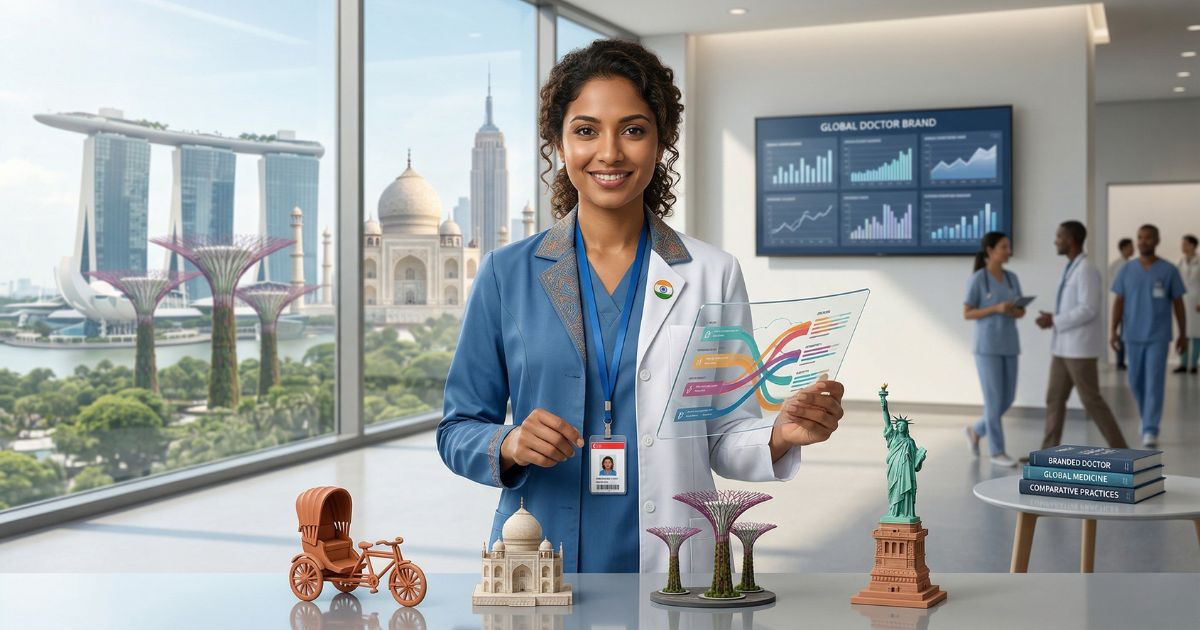
The Global Branding Gap That Nobody Talks About
In the United States, a dermatologist named Dr. Sandra Lee built a personal brand called "Dr. Pimple Popper" — now a multi-million dollar media empire with a TLC television show, 7.9 million YouTube subscribers, a skincare product line, and a book deal. Her personal brand is worth more than most hospitals.
In India, Dr. Vivek Bindra built a YouTube channel with over 22 million subscribers. Dr. Eric Berg, an American chiropractor, has 12 million YouTube subscribers and generates millions in supplement sales. In Singapore, doctors at Mount Elizabeth and Raffles Medical have branded personal practices that attract patients from across Southeast Asia.
In Bangladesh, the average doctor's "brand" is a nameplate outside their chamber door and a phone number on a prescription pad.
This is not an exaggeration. It is the reality. And at Bear My Brand, where we work with healthcare professionals across Bangladesh, we see the consequences of this gap every single day — brilliant doctors with empty appointment books while mediocre doctors with better branding fill their chambers.
USA: Where Doctors Are Media Brands
The United States is the global leader in physician personal branding. It is 10-15 years ahead of Bangladesh. Here is what the American doctor branding ecosystem looks like:
What US Doctors Do
- Professional websites with patient portals: Nearly every practicing physician in the US has a personal or practice website with online scheduling, patient reviews, insurance information, and educational content. Many cost $10,000-$50,000+ to build.
- Multi-platform social media: Top physician brands are on Instagram, TikTok, YouTube, LinkedIn, Twitter/X, and podcasts simultaneously. They produce platform-specific content for each channel.
- Video content as the primary brand tool: The most successful doctor brands are built on video — YouTube for long-form education, TikTok and Instagram Reels for short-form content. Doctors like Dr. Mike (11M+ YouTube subscribers), Dr. Eric Berg (12M+), and Dr. Pimple Popper (7.9M) have audiences larger than major media networks.
- Books and media appearances: Publishing books, appearing on talk shows, guest-hosting podcasts, and writing for mainstream media are standard brand-building strategies for ambitious US physicians.
- Product lines: Many branded US doctors launch their own product lines — skincare, supplements, wellness tools — leveraging their trusted reputation for direct revenue.
- Dedicated marketing teams: Top physician brands employ full-time content creators, videographers, social media managers, SEO specialists, and PR firms. Some spend $100,000+ per year on personal branding.
The US Doctor Branding Investment
- Average personal branding spend: $5,000-$25,000/year for typical physicians; $50,000-$200,000+ for physician influencers
- Percentage with professional website: ~85%
- Percentage active on social media: 50-60%
- Percentage with dedicated marketing support: 30-40%
American doctors treat their personal brand as a business asset — not vanity. They understand that in a competitive market with 1+ million physicians, visibility determines viability. The doctors who invest in branding consistently out-earn those who do not by 2-5x, according to multiple physician compensation studies.
India: The YouTube Doctor Explosion
India is where the doctor branding revolution is happening fastest — and it is the most relevant comparison for Bangladesh because of cultural, linguistic, and economic similarities.
What Indian Doctors Do
- YouTube-first strategy: India has produced dozens of doctor-YouTubers with 1M+ subscribers. They create educational content in Hindi, Tamil, Telugu, and English, covering everything from common health conditions to surgical procedures. The content is practical, accessible, and builds enormous trust.
- Instagram and Facebook dominance: Indian doctors use Instagram for visual specialties (dermatology, cosmetic surgery, dentistry) and Facebook for broader healthcare content. Top doctor-influencers have 500K-5M+ followers.
- Hospital-supported personal brands: Smart Indian hospital groups like Apollo, Max Healthcare, and Medanta actively invest in building their doctors' personal brands. They understand that a doctor with a strong personal brand attracts patients to the hospital. They provide content teams, videography, and marketing support to key doctors.
- Aggressive digital marketing: Indian doctors run targeted Facebook and Google ads, create landing pages for specific treatments, use WhatsApp for patient communication, and implement SEO strategies targeting patient search queries.
- Medical tourism marketing: Indian doctors actively brand themselves to international audiences — especially targeting Bangladesh, the Middle East, Africa, and Central Asia. They create content in multiple languages and participate in international health conferences as speakers.
The India Doctor Branding Investment
- Average personal branding spend: ₹200,000-₹1,000,000/year ($2,400-$12,000) for active doctors
- Percentage with professional website: ~40%
- Percentage active on social media: 25-30%
- Percentage with YouTube channel: 10-15%
"Indian doctors understood something Bangladeshi doctors have not: in the age of social media, the doctor who educates publicly is perceived as the expert — regardless of whether a quieter colleague has equal or better skills. India's doctor-YouTubers are not just building brands. They are building empires."
Bear My BrandSingapore: Premium Branding for Premium Medicine
Singapore represents the premium end of doctor personal branding — where physicians build luxury-positioned brands that command some of the highest consultation fees in the world.
What Singaporean Doctors Do
- Premium visual branding: Singaporean doctor brands look like luxury lifestyle brands — clean, minimalist websites with professional photography, premium video content, and impeccable design. The visual quality signals "world-class" before the patient reads a single word.
- International patient positioning: Singapore positions itself as Asia's medical hub. Doctors brand themselves for regional and international audiences — attracting patients from Indonesia, Myanmar, Vietnam, the Philippines, and the Middle East. Multi-language websites and international patient coordination are standard.
- Thought leadership and media: Singaporean doctors regularly appear in mainstream media, write columns in publications like The Straits Times and CNA, speak at international conferences, and publish research. This creates an authority loop: media appearances build credibility, which attracts patients, which generates case studies, which attract more media attention.
- Hospital group collaboration: Major hospital groups like Mount Elizabeth, Raffles Medical, and Gleneagles invest in building their doctors' personal brands as part of the hospital's marketing strategy. Doctors get professional photography, video production, content marketing support, and media training.
- LinkedIn as a power platform: More than in any other Asian country, Singaporean doctors use LinkedIn strategically — building referral networks with other physicians, establishing thought leadership, and attracting corporate health partnerships.
The Singapore Doctor Branding Investment
- Average personal branding spend: SGD 10,000-50,000/year ($7,500-$37,000) for specialists
- Percentage with professional website: ~60%
- Percentage active on social media: 40-50%
- Percentage with media/PR strategy: 20-30%
Singapore proves that premium branding commands premium pricing. Singaporean doctors charge consultation fees 5-10x higher than equivalent specialists in Bangladesh — and patients pay willingly because the brand signals justify the price. Branding is not a cost — it is the mechanism that allows you to charge what your expertise is actually worth.
Bangladesh: The Honest, Painful Reality
Now let us look at Bangladesh. And let us be brutally honest.
Where Bangladeshi Doctors Are Right Now
- Personal websites: Fewer than 2% of Bangladeshi doctors have a professional personal website. The ones that exist are mostly outdated, poorly designed, and not optimized for search engines.
- Social media: Fewer than 5% of doctors have a strategic social media presence. Most who have a Facebook page post irregularly — generic health tips from Google, copy-pasted content, or occasional selfies. No strategy, no consistency, no brand identity.
- Video content: Fewer than 1% of Bangladeshi doctors create regular video content. The handful who do have seen extraordinary results (Bear My Brand helped build Professor Dr. SMG Kibria's brand from zero to over 1 million Facebook followers), but they are the rare exception.
- Google Business Profile: Most doctors have not claimed their Google Business Profile. Those who have rarely update it or actively manage reviews. The average Bangladeshi doctor has 0-5 Google reviews — compared to 50-200+ for their Indian counterparts at major hospitals.
- Professional photography: Most doctor profiles use casual selfies or poorly lit photos taken on a phone. Professional headshots and brand photography are virtually non-existent.
- Marketing investment: The vast majority of Bangladeshi doctors invest BDT 0 in personal branding. Those who do invest typically spend BDT 5,000-10,000/month on low-quality social media management that does more harm than good.
The Bangladesh Doctor Branding Investment
- Average personal branding spend: BDT 0-60,000/year ($0-$540) — essentially nothing
- Percentage with professional website: ~2%
- Percentage active on social media: ~5%
- Percentage creating video content: ~1%
An average American doctor invests $5,000-$25,000 per year in personal branding. An average Indian doctor invests $2,400-$12,000. An average Bangladeshi doctor invests $0-$540. This is not a subtle gap. This is a chasm. And it directly explains why Bangladeshi patients choose Indian doctors — who they can find, see, and trust online — over Bangladeshi doctors who are invisible.
The Scoreboard: Country-by-Country Comparison
| Factor | USA | Singapore | India | Bangladesh |
|---|---|---|---|---|
| Doctors with personal website | ~85% | ~60% | ~40% | ~2% |
| Active on social media | 50-60% | 40-50% | 25-30% | ~5% |
| Creating video content | 25-30% | 15-20% | 10-15% | ~1% |
| Annual branding investment | $5K-$25K+ | $7.5K-$37K | $2.4K-$12K | $0-$540 |
| Hospital supports doctor brands | Common | Standard | Growing | Rare |
| Specialized healthcare agencies | Hundreds | Dozens | Growing fast | 2-3 |
| Doctor review platforms | Mature (Healthgrades, Zocdoc) | Established | Growing (Practo) | Non-existent |
| Patient uses online to find doctor | 77% | 70%+ | 60%+ | 85% (but doctors are not there) |
| Maturity level | Advanced | Advanced | Intermediate | Early/Nascent |
The most painful row in this table? "Patient uses online to find doctor." Bangladesh has one of the highest rates at 85% — patients are actively looking for doctors online. But the doctors are not there. The demand exists. The supply of branded, visible, trustworthy doctor brands is near zero.
That gap is an enormous opportunity for any Bangladeshi doctor willing to invest.
Why Bangladeshi Doctors Are 10 Years Behind
The branding gap is not random. It is caused by specific, identifiable factors:
1. "Branding Is Beneath Me" Mentality
Many Bangladeshi doctors view self-promotion as undignified. They believe clinical excellence should speak for itself. This was true in 1990. It is not true in 2026. In a world where patients decide on their phone before they leave their house, invisible excellence is indistinguishable from mediocrity.
2. No Healthcare Branding Ecosystem
The USA has hundreds of agencies specializing in physician marketing. India has dozens and growing fast. Bangladesh has perhaps 2-3 agencies with genuine healthcare branding expertise — one of which is Bear My Brand. Without specialized partners, doctors do not know where to start, what to invest in, or how to build strategically.
3. Cheap Agency Culture
When Bangladeshi doctors do invest in marketing, they overwhelmingly choose the cheapest option — BDT 5,000-10,000/month agencies that deliver generic, copy-pasted content. These agencies have no healthcare expertise, no brand strategy, and no understanding of patient psychology. The result is worse than no branding at all — it makes the doctor look unprofessional.
4. No Institutional Support
In the USA and Singapore, hospital groups invest in their doctors' personal brands because they understand that doctor brands drive patient acquisition. In India, this practice is growing rapidly. In Bangladesh, hospitals almost never support doctor personal branding — and some actively discourage it.
5. Regulatory Uncertainty
Many Bangladeshi doctors are unsure about BMDC regulations regarding self-promotion. This uncertainty creates paralysis. The reality: BMDC does not prohibit educational content, professional online presence, or patient testimonials with consent. But the lack of clear guidelines keeps risk-averse doctors from taking action.
6. Technology Comfort Gap
While younger Bangladeshi doctors are digital natives, the senior specialists with the most expertise and credibility are often the least comfortable with social media and digital tools. This means the doctors with the most to offer patients are the least visible online.
"At Bear My Brand, we hear the same thing from doctors every week: 'I do not know where to start.' That is the real problem. Not unwillingness — uncertainty. The system has given them no roadmap, no support, and no ecosystem. That is what we are building."
Bear My BrandWhat Bangladeshi Doctors Can Learn From Each Country
From the USA: Treat Your Brand as a Business Asset
- Your personal brand has monetary value — treat it as an investment, not an expense
- Multi-platform presence is the endgame (Facebook, YouTube, Google, website, LinkedIn)
- Video is the most powerful trust-building tool — start creating it now
- Hire professional help — you would not do your own accounting, do not do your own branding
From India: Move Fast and Own Your Niche
- YouTube is a goldmine for doctor branding — the first Bangladeshi doctor to build a massive YouTube following in Bangla will dominate
- Create content in your patients' language — Bangla and Banglish for Bangladesh, not English
- Consistency beats production quality — post regularly, improve over time
- Hospital groups should invest in doctor brands as hospital assets
From Singapore: Premium Branding Commands Premium Fees
- Invest in visual quality — professional photography, clean website design, premium video
- Position yourself for the premium segment — strong brands justify higher fees
- Think regionally — with digital, your brand can attract patients beyond Bangladesh
- Use LinkedIn for physician referral networks and thought leadership
The Opportunity Hiding in the Gap
Here is the counterintuitive truth: Bangladesh being 10 years behind is actually the biggest opportunity in South Asian healthcare branding.
In the USA, the market is saturated. Standing out requires massive investment. In India, competition is intensifying rapidly. But in Bangladesh? The field is wide open.
A Bangladeshi doctor who starts building a strategic personal brand today will face almost zero competition. The first cardiologist to build a strong Facebook and YouTube presence in Bangla will own that space. The first orthopedic surgeon. The first gynecologist. The first pediatrician. Every specialty is an unclaimed territory.
Five years from now, when every doctor in Bangladesh is trying to build a brand, the early movers will already have hundreds of thousands of followers, years of content, algorithmic authority, and patient trust that newcomers cannot replicate. The compound interest of early branding investment is enormous.
We have mapped every medical specialty in Bangladesh against current online branding competition. The result: in 90% of specialties, there is NO doctor with a strong, strategic personal brand. Zero. This means the first doctor in each specialty to build a real brand will establish dominance by default. We are actively helping doctors claim these positions before their colleagues wake up. The window will not stay open forever.
The Roadmap: From 10 Years Behind to Leading
Bangladesh does not need 10 years to close the gap. With the right strategy and intensity, a Bangladeshi doctor can build a brand that rivals any Indian doctor-influencer within 18-24 months. Here is how:
Phase 1: Foundation (Month 1-2)
- Define your niche, brand voice, and positioning with a specialized branding partner
- Professional headshot and brand photography session
- Launch a professional website with SEO, online booking, and patient testimonials
- Set up and optimize Facebook Page, YouTube channel, and Google Business Profile
- Design visual brand system (logo, colors, templates) for consistent content
Phase 2: Content Engine (Month 3-6)
- Post 5-7 times per week on Facebook (minimum 3 videos)
- Launch YouTube with 1-2 educational videos per week
- Batch-create content — one recording session per week produces 5-7 pieces
- Collect patient testimonials systematically (2-3 per month)
- Collect Google reviews aggressively (target 50+ in first 6 months)
- Engage in health-related Facebook groups and community discussions
Phase 3: Growth and Authority (Month 7-12)
- Amplify top-performing content with paid advertising
- Collaborate with other branded doctors for cross-promotion
- Pursue media appearances — local TV health segments, podcast interviews, newspaper columns
- Launch LinkedIn for physician referral network building
- Analyze metrics monthly and double down on what works
Phase 4: Dominance (Month 13-24)
- Scale content to daily production across multiple platforms
- Build a team (content creator, video editor, social media manager)
- Explore product opportunities (courses, books, health tools)
- Position for medical tourism — attract Bangladeshi diaspora and regional patients
- Become the recognized authority in your specialty in Bangladesh
"The gap between Bangladesh and the rest of the world is not a verdict — it is an invitation. The doctors who accept that invitation today will build the most valuable personal brands in Bangladeshi healthcare history."
Bear My BrandFrequently Asked Questions
Common questions about doctor personal branding globally.
Ready to Close the Branding Gap?
Bear My Brand builds doctor personal brands that compete globally — not just locally. From zero followers to market-leading authority, we help Bangladeshi doctors build brands their patients can actually find and trust.
Book a Free Strategy Call