
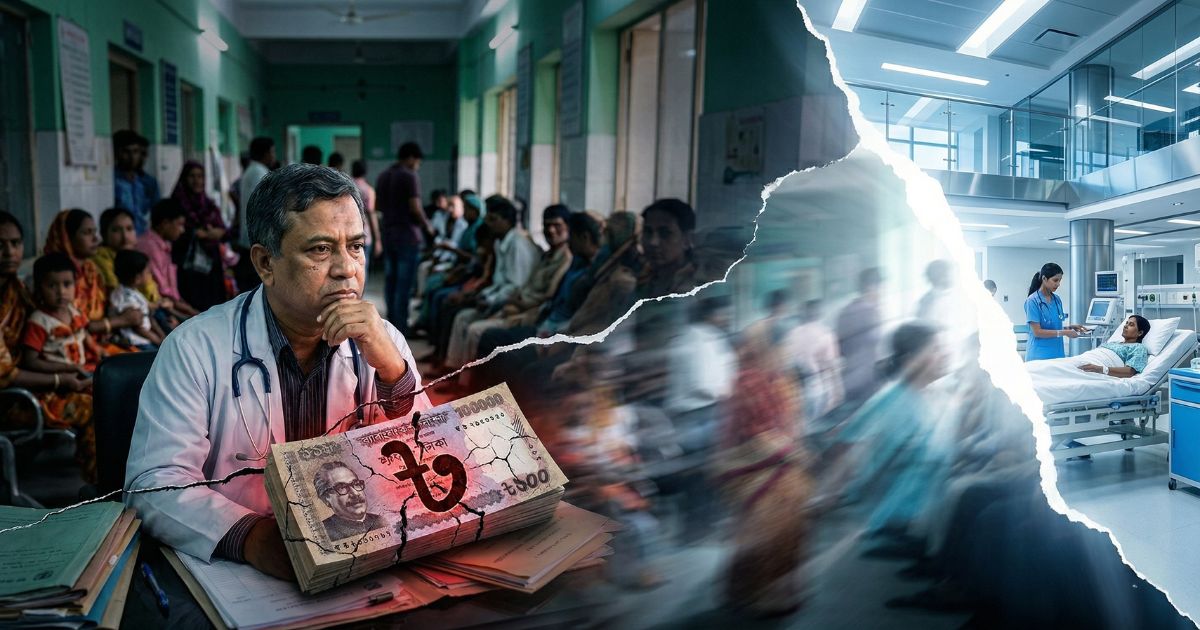
The Number That Should Make Every Bangladeshi Doctor Angry
৳5,000 crore. That is approximately $4 to $5 billion. Every single year. Flowing out of Bangladesh into the pockets of Indian, Singaporean, Thai, and Malaysian hospitals.
In 2024 alone, approximately 482,000 Bangladeshis traveled to India for medical treatment. That is more than from any other country in the world. Bangladesh accounts for 52% of India's entire inbound medical tourism. We are, quite literally, Apollo Hospital's biggest customer.
Let that sink in. Half of every patient who walks into a major Indian hospital from another country is Bangladeshi.
And here is the part that should make you furious: the majority of these patients are traveling for treatments that are available in Bangladesh. Cardiac surgery. Cancer treatment. Orthopedic procedures. Kidney transplants. Neurosurgery. We have doctors trained at the same institutions as their Indian counterparts. We have hospitals with comparable equipment. We have the clinical capability.
What we do not have is trust.
"When a Bangladeshi patient books a flight to Chennai for heart surgery that could be performed in Dhaka, they are not making a medical decision. They are making a branding decision. They are choosing the doctor they trust — and right now, that doctor does not look Bangladeshi."
Bear My BrandThe Real Reasons Patients Leave (It Is Not What You Think)
Ask hospital administrators in Bangladesh why patients go abroad and they will list predictable answers: "We need better equipment." "We need more specialists." "The government does not invest enough."
These are convenient answers. They are also largely wrong.
Research from multiple studies — including surveys by the Bangladesh Medical Association and international health tourism organizations — paints a very different picture. Here are the actual reasons Bangladeshi patients fly to India:
1. "I Don't Trust Bangladeshi Hospitals" (Perception, Not Reality)
This is the number one reason. Not lack of equipment. Not lack of skill. Lack of trust.
And where does this perception come from? It comes from branding. Apollo looks trustworthy because Apollo invested in looking trustworthy — $15-20 million per year in brand building, a world-class website, doctor profiles with video introductions, thousands of published patient testimonials, transparent pricing, 24/7 international patient coordination.
Meanwhile, some of the largest hospitals in Dhaka have websites that look like they were built in 2008. No doctor profiles. No patient testimonials. No online booking. No content. Nothing that says "trust us with your life."
2. "The Doctor Did Not Spend Time With Me"
The second most cited reason is doctor communication. Patients report feeling rushed, dismissed, and confused after consultations. A 3-minute consultation after a 2-hour wait. Medical jargon without explanation. No written treatment plan. No follow-up.
Contrast this with the Indian hospital experience: a dedicated patient coordinator who speaks Bangla, detailed treatment explanations, written care plans, transparent cost breakdowns, and post-discharge follow-up calls.
The clinical outcome may be identical. But the experience is not. And patients choose based on experience.
3. "The Hospital Did Not Feel Professional"
Overcrowded lobbies. Confusing wayfinding. Rude or indifferent reception staff. Unclear billing. Long waits with zero communication. Dirty corridors. Broken equipment in waiting rooms.
These are not clinical issues. They are brand experience issues. And patients use them as proxy signals for clinical quality. A patient who sees a dirty waiting room thinks: "If they cannot maintain their lobby, can they maintain my heart?"
4. "My Relative in India Said Go There"
Word-of-mouth drives a massive portion of medical tourism. Once a family has one positive experience at Apollo or Fortis, they become evangelists. "Go to Apollo. My uncle had surgery there. They were amazing." This creates a self-reinforcing cycle: Indian hospitals get more patients, generate more success stories, create more word-of-mouth, and attract even more patients.
Bangladeshi hospitals rarely create this advocacy loop because they do not invest in patient experience, testimonial collection, or post-visit engagement.
5. "Indian Hospitals Contacted ME"
This is the one most Bangladeshi hospitals do not realize. Apollo, Fortis, Medanta, and other Indian chains actively market to Bangladeshi patients. They run Facebook ads targeting Bangladesh. They have local agent networks in Dhaka, Chittagong, and Sylhet. They offer free second opinions. They provide Bangla-speaking coordinators, airport pickup, hotel booking, and visa assistance.
Indian hospitals are spending money to acquire your patients. And they are succeeding because you are spending nothing to retain them.
At Bear My Brand, we have consulted with hospitals across Bangladesh. The pattern is always the same: brilliant doctors, capable staff, adequate facilities — and zero investment in brand, digital presence, or patient experience design. The doctors are not the problem. The branding vacuum is the problem. And it is costing the entire country billions.
What Apollo Spends vs What Bangladeshi Hospitals Spend
The numbers tell the story better than any argument:
Apollo Hospitals (India)
- Marketing budget: $15-20 million per year across 73+ hospitals
- Website: 500+ pages of optimized content, doctor profiles with video, treatment cost estimators, virtual tours, multi-language support
- Digital marketing team: 50+ professionals dedicated to SEO, social media, paid advertising, and content creation
- International patient program: Dedicated teams for 15+ countries, local agents, Bangla-speaking coordinators
- Patient experience: Designed and measured systematically with regular patient satisfaction surveys, mystery patients, and experience audits
Average Large Bangladeshi Hospital
- Marketing budget: Less than 1% of revenue — mostly newspaper ads and billboards
- Website: 5-10 pages, often outdated, no doctor profiles, no testimonials, no booking
- Digital marketing team: 0-1 person (usually a junior "IT guy" who also handles social media)
- International patient program: Non-existent
- Patient experience: Not measured, not designed, not prioritized
This is not a competition. This is a massacre. And Bangladeshi hospitals are losing it in slow motion.
The Branding Gap: A Side-by-Side Comparison
Let us walk through what a Bangladeshi patient sees when they are deciding between a local hospital and an Indian one:
Step 1: Google Search
Indian hospital: Appears on the first page with rich snippets, star ratings, doctor profiles, treatment cost ranges, and multiple content pieces answering the patient's exact question.
Bangladeshi hospital: Appears on page 2 or 3 — if at all. Basic listing with no reviews, no photos, no compelling description.
Step 2: Website Visit
Indian hospital: Modern, fast, mobile-responsive. Detailed department pages. Each doctor has a profile with photo, bio, credentials, specializations, and patient reviews. Treatment pages explain the procedure, recovery time, and cost range. Online appointment booking. WhatsApp integration. Virtual tour.
Bangladeshi hospital: Slow-loading, dated design. Generic "About Us" page. No individual doctor profiles. No treatment information. No online booking. "Call for appointment" with a number that rings busy.
Step 3: Social Media Check
Indian hospital: Active Facebook page with daily content — doctor videos, patient testimonials, health tips, live Q&A sessions. Hundreds of thousands of followers. Active engagement in comments.
Bangladeshi hospital: Facebook page last updated 3 months ago. Generic Canva health tips. 500 followers. Zero engagement.
Step 4: Reviews and Testimonials
Indian hospital: 2,000+ Google reviews at 4.5 stars. Professional video testimonials on website and YouTube. Published case studies.
Bangladeshi hospital: 12 Google reviews at 3.2 stars. No testimonials on website. No video content.
Now ask yourself: if you were a worried patient about to undergo heart surgery, which hospital would you trust?
That is the ৳5,000 crore question. And the answer is obvious.
"We have seen world-class Bangladeshi surgeons who could operate circles around their Indian counterparts — sitting in half-empty chambers while Apollo fills beds with Bangladeshi patients. That is not a healthcare failure. That is a branding crime."
Bear My Brand — from our work with healthcare clients across BangladeshThe 6 Things Indian Hospitals Do to Steal Your Patients
Indian hospitals have a systematic playbook for acquiring Bangladeshi patients. Understanding it is the first step to fighting back:
- Targeted Facebook and Google ads in Bangladesh. They run ads in Bangla targeting Dhaka, Chittagong, Sylhet, and other major cities. "Free second opinion from Apollo specialists" is one of their most effective ad formats.
- Local agent networks. Indian hospitals have agents embedded in major Bangladeshi cities. These agents receive commissions for every patient they refer. Some operate from medical travel agencies, some from pharmacies, and some are informal referral networks among brokers.
- Free telemedicine consultations. Many Indian hospitals offer free initial consultations via video call — specifically targeting Bangladeshi patients who are considering treatment. This builds personal connection before the patient even decides to travel.
- Complete patient packages. Airport pickup in India, hotel accommodation, Bangla-speaking coordinator, visa assistance, post-surgery accommodation, follow-up coordination. The patient does not have to think about logistics — just show up.
- Doctor personal brands. Indian specialists have massive personal brands on social media. A Bangladeshi patient can watch 50 videos of the Apollo cardiologist explaining heart conditions before they book. They feel like they know the doctor. They trust the doctor. The Bangladeshi cardiologist with zero online presence? Invisible.
- Systematic testimonial marketing. Indian hospitals collect and publish patient stories from every country they serve — including Bangladesh. A Bangladeshi patient sees another Bangladeshi patient sharing their positive Apollo experience on video. That is the most powerful marketing in existence.
In our work with healthcare clients across Bangladesh, we have mapped the Indian hospital marketing machine in detail. The sophistication is staggering — and the Bangladeshi response is essentially non-existent. The good news: every single one of these tactics can be replicated and even improved upon by Bangladeshi hospitals. The bad news: almost nobody is doing it.
What This Is Actually Costing Bangladesh
The ৳5,000 crore outflow is just the direct cost — money paid to foreign hospitals. The actual economic damage is far greater:
- Lost hospital revenue: ৳5,000 crore per year that could fund hospital expansion, equipment upgrades, and doctor salaries in Bangladesh
- Lost jobs: Every patient treated in India instead of Bangladesh represents lost employment for nurses, technicians, support staff, and administrators
- Brain drain acceleration: When doctors see empty chambers and declining patient volumes, the best ones leave for countries where they can build successful practices. This further weakens Bangladesh's healthcare capacity.
- Foreign exchange pressure: $4-5 billion leaving the country every year puts pressure on the taka and the current account
- Tax revenue loss: Income tax, VAT, and corporate tax on healthcare services that are instead being paid to the Indian and Singaporean governments
- Innovation stagnation: Without patient volume and revenue, hospitals cannot invest in new treatments, research, or technology — creating a downward spiral
When you add the indirect costs — lost jobs, brain drain, foreign exchange pressure, foregone tax revenue — the true cost of Bangladesh's healthcare branding failure is likely ৳10,000-15,000 crore per year. That is not a rounding error. That is a national economic crisis hiding in plain sight.
The Solution Is Not More Hospitals — It Is Better Brands
Bangladesh does not need more hospital beds to solve this problem. Bangladesh needs better hospital brands.
The solution exists. It is not theoretical. It is proven. And it is surprisingly affordable compared to the cost of doing nothing.
For Individual Doctors
- Build your personal brand on social media. Start with Facebook. Record educational videos 3-5 times per week. Speak in Bangla. Be authentic. Patients choose doctors they feel they know — and video is the fastest way to build that familiarity.
- Claim and optimize your Google Business Profile. This single action can generate patient calls from day one. Add professional photos, list all services, and actively collect reviews from satisfied patients.
- Get a professional website. Not a generic template — a strategic, SEO-optimized website that positions you as the authority in your specialty. Include your bio, credentials, patient testimonials, educational content, and online booking.
- Invest in patient experience. Listen to patients. Explain in simple language. Follow up after visits. These cost nothing and build more trust than any advertisement.
For Hospitals and Clinics
- Invest in comprehensive brand strategy. Define your positioning. Redesign your visual identity. Build a world-class website. Launch systematic digital marketing.
- Build your doctors' personal brands as hospital assets. Every star doctor should have their own profile page, video content, and social media presence — under your hospital umbrella.
- Design the patient experience end-to-end. From the first Google search to the post-discharge follow-up call. Map every touchpoint. Fix every friction point.
- Launch an international patient program. If you are a major hospital, start actively marketing to the Bangladeshi diaspora and regional patients. The same playbook Indian hospitals use can work for you.
- Hire specialized healthcare branding partners. Not a generic digital marketing agency that also handles restaurants and clothing brands. A partner that understands healthcare, patient psychology, and the competitive dynamics of medical tourism.
For the Healthcare Industry
- Industry-wide branding initiative. Bangladesh needs a "Made in Bangladesh" equivalent for healthcare — a trust mark or quality certification that signals to patients that local hospitals meet international standards.
- Accreditation push. JCI (Joint Commission International) accreditation or equivalent certifications give hospitals credible third-party validation that patients trust.
- Medical tourism marketing board. A coordinated national effort to brand Bangladesh as a healthcare destination, not just a healthcare exporter.
At Bear My Brand, we specialize in exactly this problem. We have built doctor personal brands from zero to hundreds of thousands of followers. We have designed healthcare brand strategies for clinics and hospitals. We understand the intersection of medical credibility and digital marketing — and we know that the gap between Bangladeshi and Indian healthcare branding is entirely closable. It requires investment, strategy, and commitment. But the ROI is not just financial — it is national.
The Window Is Closing
Right now, the healthcare branding space in Bangladesh is wide open. Almost no hospital is doing it well. Almost no doctor has a strategic personal brand. The first movers will dominate.
But that window will not stay open forever. Indian hospitals are increasing their marketing spend in Bangladesh. More local hospitals are beginning to wake up to the branding opportunity. Digital marketing costs in Bangladesh are rising year over year as competition increases.
The doctors and hospitals that invest in branding now — in 2026 — will be the ones who own the market position, the SEO rankings, the social media following, and the patient trust by 2030. The ones who wait will be playing catch-up for a decade.
The ৳5,000 crore mistake does not have to be permanent. But fixing it requires the same thing that caused it: a decision. Indian hospitals decided to invest in their brands 20 years ago. Bangladeshi hospitals decided not to.
It is time to make a different decision.
"Bangladesh does not have a healthcare quality problem. Bangladesh has a healthcare branding problem. And branding problems are solvable — if you have the courage to invest in the solution before your competitors do."
Bear My BrandFrequently Asked Questions
Common questions about Bangladesh's medical tourism crisis.
Stop the Patient Outflow. Build a Brand They Trust.
Bear My Brand builds healthcare brands that compete — doctor personal brands, hospital brand strategies, digital presence, and patient acquisition systems. If you are ready to stop losing patients to Apollo, let's talk.
Book a Free Strategy Call