
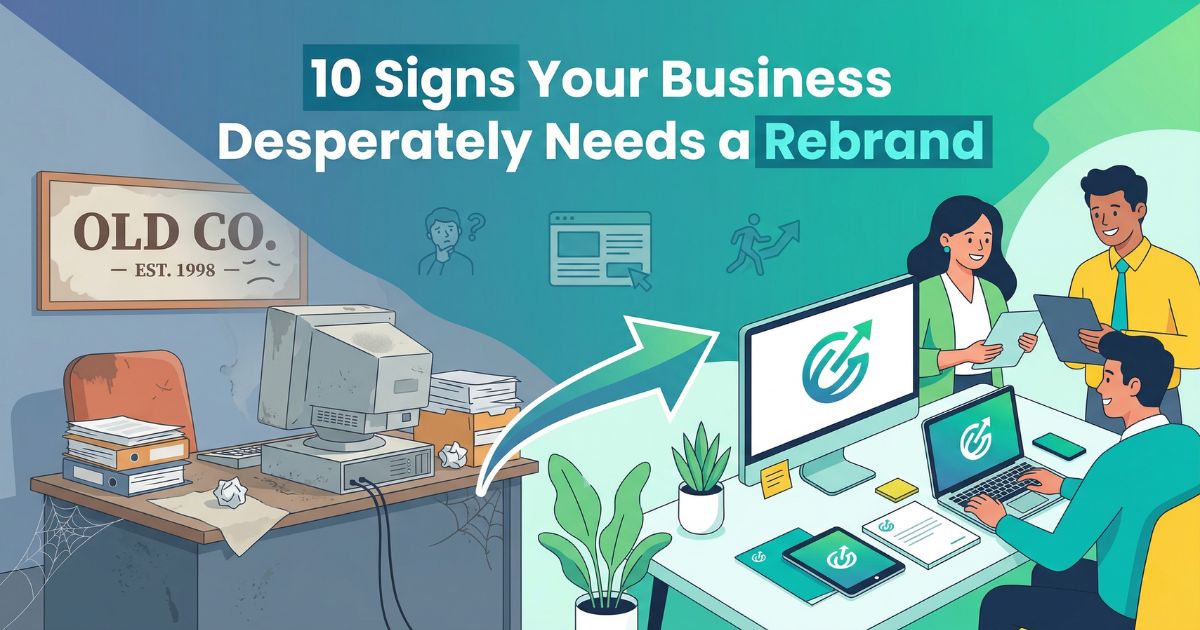
Before We Start: Rebrand vs Refresh
Let's get the terminology right because most people use "rebrand" when they actually mean "refresh" — and the difference matters.
A brand refresh is cosmetic. You update the logo, modernise the colours, redesign the website. The core identity — who you are, what you stand for, who you serve — stays the same. Think of it as repainting your house.
A full rebrand changes the foundation. New positioning, new messaging, sometimes a new name. The entire perception of your business shifts. This is moving to a new house entirely.
Most businesses need a refresh every 3-5 years. A full rebrand happens every 7-10 years, or after a significant business change — a pivot, a merger, a crisis, or a fundamental shift in the market.
Now let's talk about the signs that tell you which one you need.
Sign #1: You Are Embarrassed to Hand Out Your Business Card
This one sounds trivial. It is not. If you hesitate before sharing your website URL, if you cringe when you pull out your business card, if you find yourself saying "we are working on updating our look" — your brand is actively hurting you.
First impressions are formed in 0.05 seconds. That is 50 milliseconds. Before anyone reads your copy, understands your value proposition, or evaluates your pricing, they have already made a snap judgement based on how your brand looks and feels. If that judgement is "outdated" or "amateur," everything else you do has to fight uphill.
The embarrassment test is honest. Trust it.
Sign #2: Your Brand Looks Like It Was Built in a Different Era
Design trends evolve. What looked cutting-edge in 2018 looks dated in 2026. Glossy gradients, heavy drop shadows, clip art-style icons, busy layouts, cursive script logos — these were acceptable at some point. That point has passed.
But here is the nuance: you should not chase trends. A good brand should feel timeless, not trendy. The problem is not that your brand does not look like what is fashionable this year. The problem is when your brand looks like it belongs to a specific past era — when it signals that your business has not evolved.
If someone can accurately guess the decade your brand was designed, it is probably time for an update.
Sign #3: You Are Attracting the Wrong Customers
This is the sign most people miss, and it is often the most expensive one. Your brand is a filter. It attracts certain people and repels others. If you are consistently attracting customers who do not fit — they want the cheapest option, they do not value what you do, they are not in your target market — your brand is sending the wrong signal.
A premium brand attracts premium clients. A discount-looking brand attracts discount-seeking buyers. Your visual identity, your messaging, your pricing presentation — all of it tells people what kind of business you are before you ever speak to them.
If you want to move upmarket — charge more, work with better clients, attract better talent — your brand needs to get there first. Your brand is the promise; the experience is the delivery. If the promise is "budget," the experience cannot convince people otherwise.
Look at your last 10 clients. How many of them are your ideal client? If the answer is less than 5, your brand positioning is off. It is attracting the wrong people because it is communicating the wrong message.
Sign #4: Your Competitors Look Better Than You
Open your website and your top 3 competitors' websites side by side. Be honest. If their brand identity — their site, their social media, their collateral — looks significantly more professional, polished, and cohesive than yours, you have a problem.
This is not about vanity. This is about perceived value. When a potential customer is comparing two similar businesses, they choose the one that looks more trustworthy and professional. That is not a conscious decision — it is a psychological reflex. And the brand that looks better wins that reflex every time.
According to Stanford's Web Credibility Research, 75% of users judge a company's credibility based on the design of its website. Not the content. Not the testimonials. The design.
Sign #5: You Have Merged, Pivoted, or Expanded
Your brand was built around a specific business reality — the products you sold, the market you served, the size of your team. If any of those have fundamentally changed, your brand needs to catch up.
Common triggers:
- Merger or acquisition: Two brands need to become one coherent identity
- New product lines: Your brand was built for one offering and now represents many
- New markets: You started local and now serve globally (or vice versa)
- Business model change: You shifted from product to service, or B2B to B2C
- Team growth: From solo founder to a team of 50 — the brand needs to represent the company, not just the person
Sign #6: Your Brand Is Inconsistent Across Touchpoints
Your website uses one colour palette. Your Instagram uses different fonts. Your proposals use a slightly different logo. Your email signature does not match your business cards. Sound familiar?
Brand inconsistency is the silent killer of trust. Research from Lucidpress shows that consistent brand presentation across all platforms increases revenue by up to 23%. Every inconsistency — no matter how small — signals to customers that you do not have your act together.
If your brand is inconsistent, it usually means one of two things: you never had proper brand guidelines, or the guidelines exist but nobody follows them because they are outdated or impractical. Either way, a rebrand that includes comprehensive, usable guidelines solves the problem at its root.
Sign #7: Your Name Does Not Fit Anymore
Maybe you started as "Smith Web Design" and now you offer full-service digital marketing. Maybe your name is hard to spell, impossible to find on Google, or means something unfortunate in a market you have expanded into. Maybe you chose a trendy name in 2015 that now makes you sound like every other startup.
A name change is the most drastic form of rebranding, and it is not always necessary. But when the name is genuinely holding you back — limiting what you can offer, confusing customers, or making you invisible in search — it is worth the pain of changing it.
A name change means starting your brand recognition from scratch. Do not change your name because you are bored with it. Only change it when it is actively limiting your business growth or misrepresenting what you do.
Sign #8: You Cannot Charge Premium Prices
Pricing is not just about what you deliver. It is about what people believe they are getting. And belief is shaped by brand perception.
Walk into two coffee shops. One has hand-lettered signage, ceramic cups, jazz playing, warm lighting. The other has a laminated menu, plastic chairs, and fluorescent lights. They both serve espresso. You will pay $6 at the first one and expect $2 at the second.
The coffee might be identical. The brand experience is not.
If you are consistently losing deals on price — if customers tell you "we went with someone cheaper" — it might not be your pricing that is wrong. It might be that your brand is not communicating enough value to justify the price. A strong brand is the best pricing strategy you will ever have.
Sign #9: You Have a Negative Reputation to Outrun
Sometimes a rebrand is not about growth — it is about survival. A public crisis, bad press, a viral customer complaint, a product recall, a scandal — these events can permanently damage a brand's reputation. At some point, it becomes more expensive to rehabilitate the old brand than to build a new one.
This is the least pleasant reason to rebrand, but it is a valid one. Companies like Blackwater (now Academi), Philip Morris (now Altria), and ValuJet (now AirTran) all rebranded after reputational crises. The name change alone did not fix the problem — but combined with genuine operational changes, it gave the business a second chance.
A rebrand without actual change underneath it is just lipstick on a pig. The market sees through it fast.
Sign #10: Growth Has Plateaued and You Cannot Figure Out Why
You have tried new marketing channels. You have adjusted your pricing. You have expanded your offerings. You have hired better salespeople. And growth is still flat.
Sometimes the ceiling is the brand itself. When a brand reaches a certain level of awareness and saturation, it hits a wall. The people who were going to respond to the current brand have already responded. Growth requires reaching new segments, and new segments require a different brand perception.
This is why 74% of S&P 100 companies rebrand within their first 7 years. Not because the old brand was bad — but because the business outgrew it. The brand that gets you from 0 to $1M is not the brand that gets you from $1M to $10M. And the brand that gets you to $10M is definitely not taking you to $100M.
"A brand is a living thing. It either grows with your business or it becomes the cage that keeps your business small."
Bear My BrandHow to Rebrand Without Losing Everything
Deciding to rebrand is the first step. Doing it right is what determines whether it works. Here is the process that separates successful rebrands from expensive disasters.
Step 1: Audit What You Have
Before you change anything, understand what is working and what is not. Audit your current brand across every touchpoint: website, social media, print materials, email templates, signage, packaging. Talk to customers. Run surveys. Look at analytics. What do people actually associate with your brand today?
Step 2: Define What Needs to Change (and What Does Not)
Not everything needs to go. Some elements of your current brand might have strong recognition and positive associations. Throwing those away is wasteful. Identify what to keep, what to evolve, and what to replace entirely.
Step 3: Strategy Before Design
Define your new positioning, target audience, brand values, and messaging framework before anyone opens a design tool. This is the step that amateur rebrands skip — and it is the step that determines whether the rebrand actually solves the problem or just creates a prettier version of the same problem.
Step 4: Design the New Identity
With strategy locked in, design the visual and verbal identity: logo, colour palette, typography, imagery style, brand voice, and all the elements that make the brand tangible and consistent.
Step 5: Plan the Rollout
A rebrand launch is a project in itself. You need to update every touchpoint simultaneously or in a coordinated sequence: website, social media, email, print materials, signage, packaging, uniforms, vehicle wraps — everything. A half-rolled-out rebrand is worse than no rebrand at all because it creates exactly the inconsistency you are trying to eliminate.
Step 6: Communicate the Change
Tell your customers, your team, your partners, and your market what is happening and why. The "why" matters more than the "what." People resist change. But when they understand the reason behind it — "we have grown beyond our original brand" or "we are refocusing on the customers who matter most" — they get on board.
- Audit all existing brand touchpoints before changing anything
- Interview at least 10 customers about their perception of your brand
- Complete brand strategy before starting any design work
- Create comprehensive brand guidelines for consistency
- Plan a coordinated rollout — do not go halfway
- Communicate the change to customers, team, and partners with clear reasoning
- Monitor brand metrics for 6-12 months post-launch
Frequently Asked Questions
Common questions about rebranding your business.
Ready for a Rebrand?
Bear My Brand has helped dozens of businesses rebrand strategically — from research and positioning to design, launch, and beyond.
Book a Free Strategy Call